

The bird lands on the fence post. You have the wide lens on. By the time the long lens is out of the bag and on the camera, the post is empty.
The Sigma 16-300mm F3.5-6.7 DC OS Contemporary is built so that never happens. It is a single zoom lens for APS-C mirrorless cameras that goes from a wide 16mm to a 300mm super-telephoto, an 18.8x range. Sigma calls it the world’s first mirrorless lens with a zoom ratio that large. It also focuses close enough for half life-size close-ups, and it has optical stabilization built in.
We unboxed the lens and mounted it on a Sony FX30. This review shows the box and what comes with it, the lens on the camera from every side, and what the specifications mean when you are out shooting. Every specification here comes from Sigma’s official product page.
Problem 1: a bag full of lenses
One lens covers 16mm to 300mm and weighs 615 g in Sony E-mount.
Problem 2: shaky long shots
Optical stabilization gives 6 stops at the wide end and 4.5 stops at the telephoto end.
Problem 3: no close-up lens
A maximum magnification of 1:2 at 70mm covers flowers, food and small details.
Disclosure: This post contains affiliate links. If you buy through them, we may earn a commission at no extra cost to you.
The Quick Answer
The Sigma 16-300mm is for people who want to carry one lens and be ready for almost anything: travel, family, events, wildlife at a distance and close-ups. The price of that range is light. The maximum aperture is F3.5 at the wide end and F6.7 at 300mm, so it is at its best outdoors and in good light. It is made for APS-C cameras only, and it does not replace a fast lens for dark rooms or for a very blurred background.
SIGMA 16-300MM · APS-C
Sigma 16-300mm F3.5-6.7 DC OS Contemporary
✔ 18.8x zoom range ✔ Optical stabilization ✔ 1:2 close-ups
Price and stock change often. Pick the version for your camera mount before you order.
Unboxing the Sigma 16-300mm
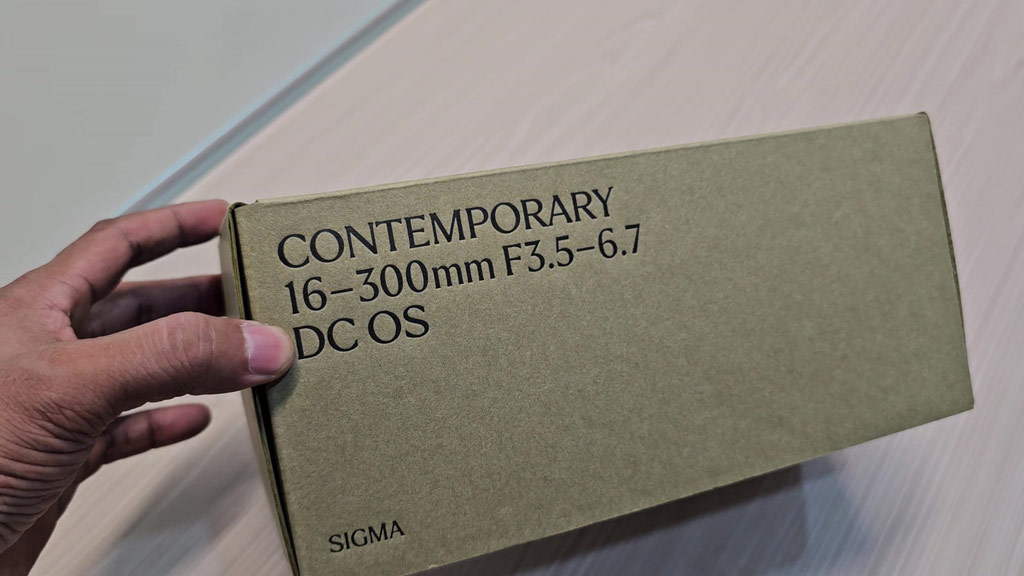
The lens comes in a plain olive-green cardboard box with no product photo. The text is small and dark: Contemporary, 16-300mm F3.5-6.7, DC OS, with the Sigma name in the corner. It looks more like packaging for a watch than for camera gear.
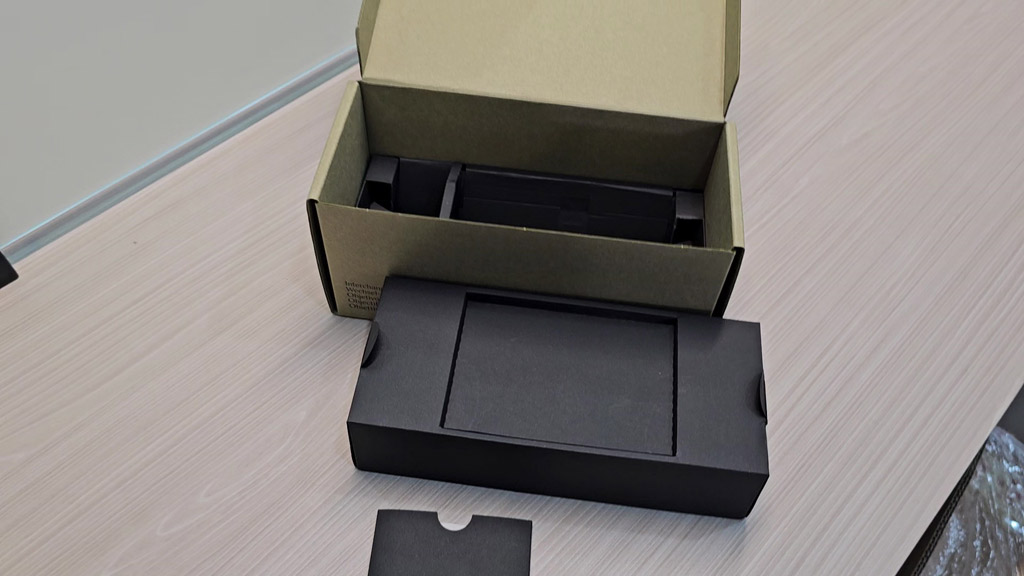
Inside is a black moulded tray that holds the lens, and a black card sleeve embossed with “Sigma Aizu Japan”. Aizu is where Sigma makes its lenses, and the barrel of ours is marked Made in Japan.
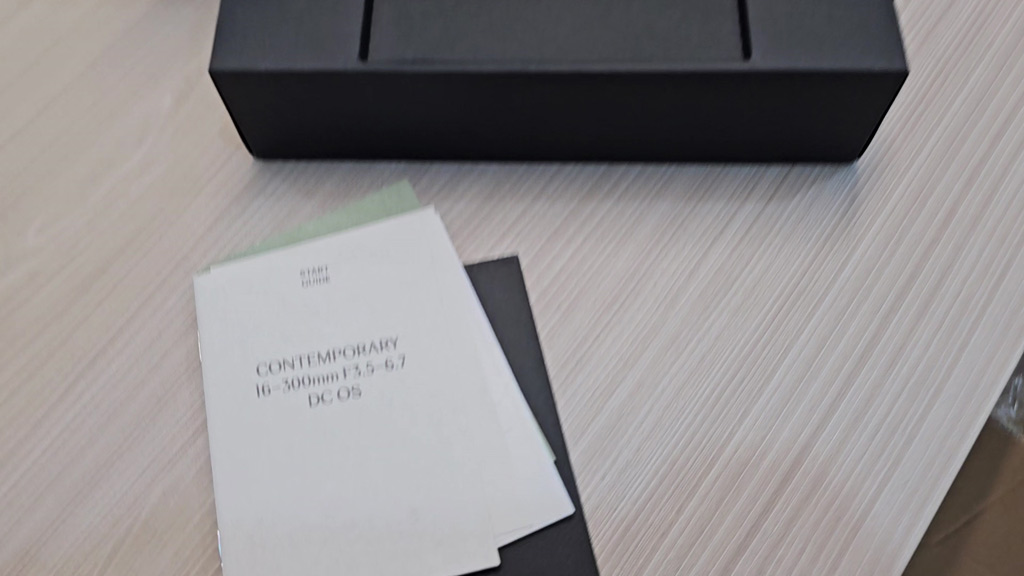
The sleeve holds the paperwork for the lens.
Everything in the Box, and What You Still Need
| Item | In the box | What it is for |
|---|---|---|
| 16-300mm lens | Yes | The lens, in the mount you ordered. |
| Lens hood LH706-03 | Yes | Blocks stray light and protects the front element. |
| Front cap LCF-67 IV | Yes | Covers the front of the lens. |
| Rear cap LCR III | Yes | Covers the mount end. |
| Pouch | Yes | Soft storage for the lens. |
| APS-C mirrorless camera | No | The lens is made for APS-C sensors. |
| 67mm filters | No | Protector or polarizing filters are sold separately. |
The supplied accessories are from Sigma’s official list. Sigma also sells a USB Dock UD-11 and several 67mm filters for this lens separately.
A Tour of the Lens
On the camera
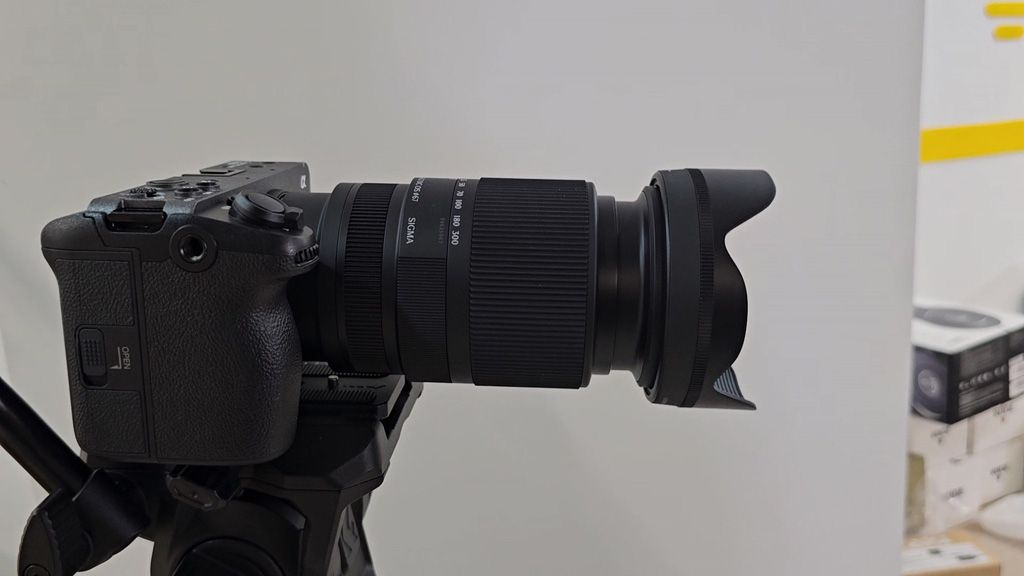
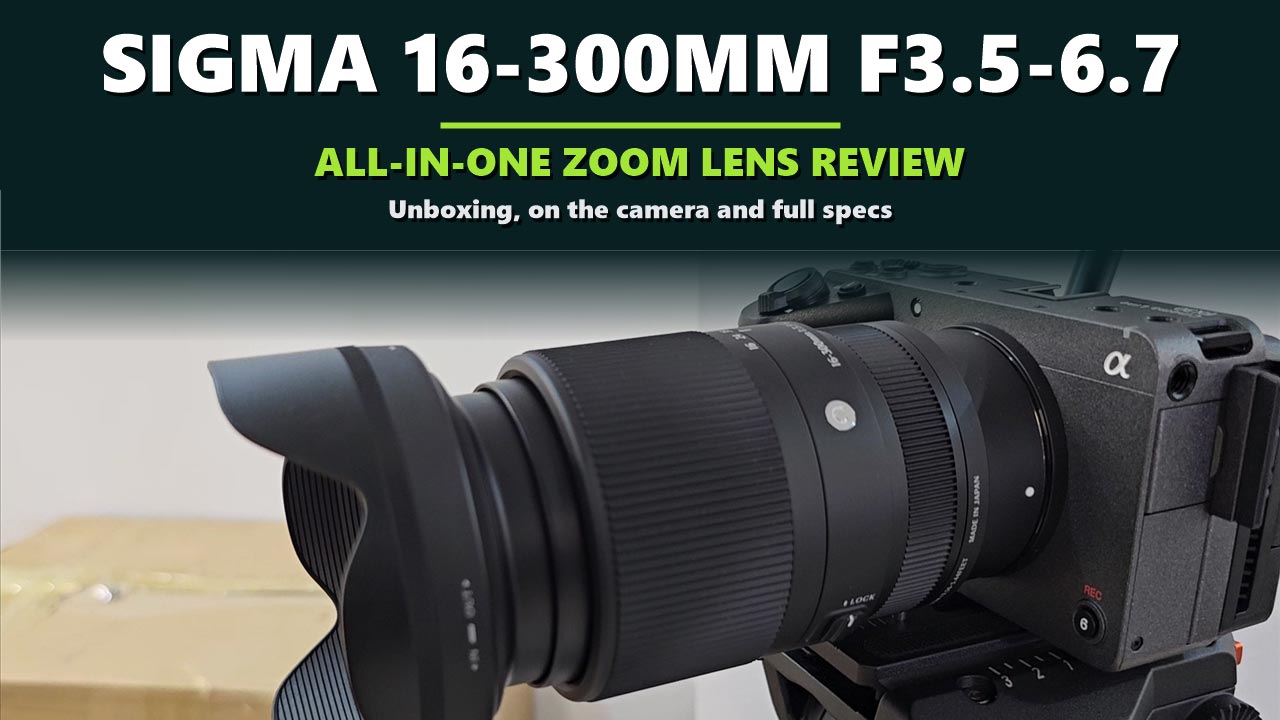
Here is the lens on our Sony FX30 with the hood fitted. For a lens that reaches 300mm it is short. The Sony E-mount version is 73.8mm wide, 123.4mm long and weighs 615 g. It balances on a small camera body without pulling the front down hard.
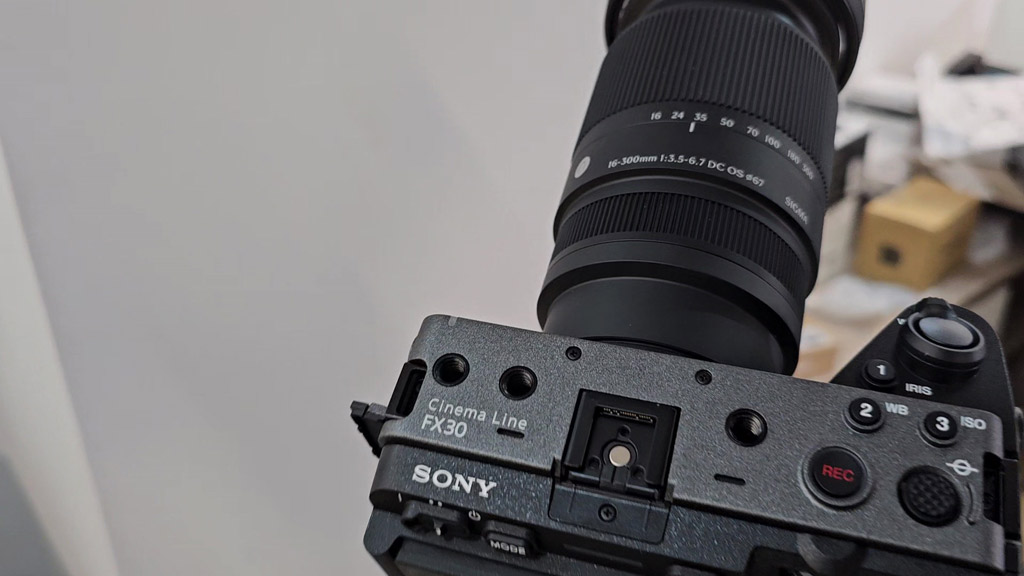
The barrel and the zoom scale
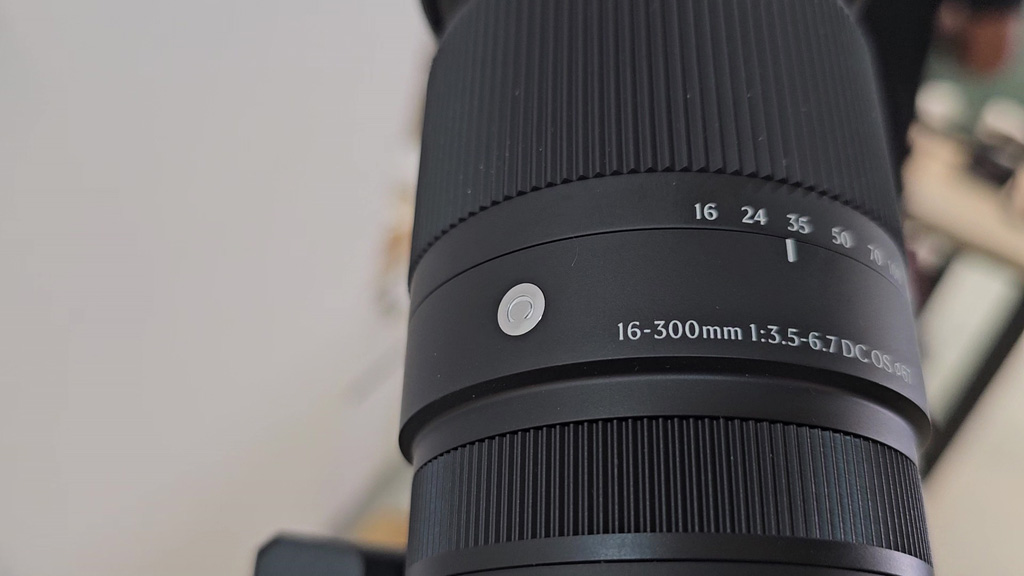
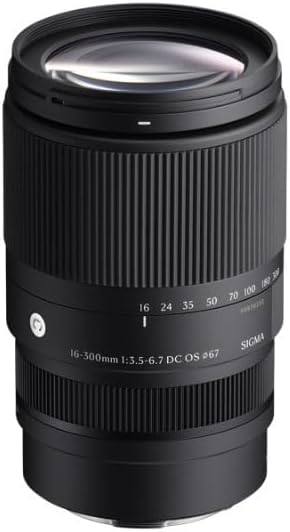
The barrel is matte black with a wide ribbed zoom ring. The name ring reads 16-300mm 1:3.5-6.7 DC OS, next to the silver “C” badge of the Contemporary line.
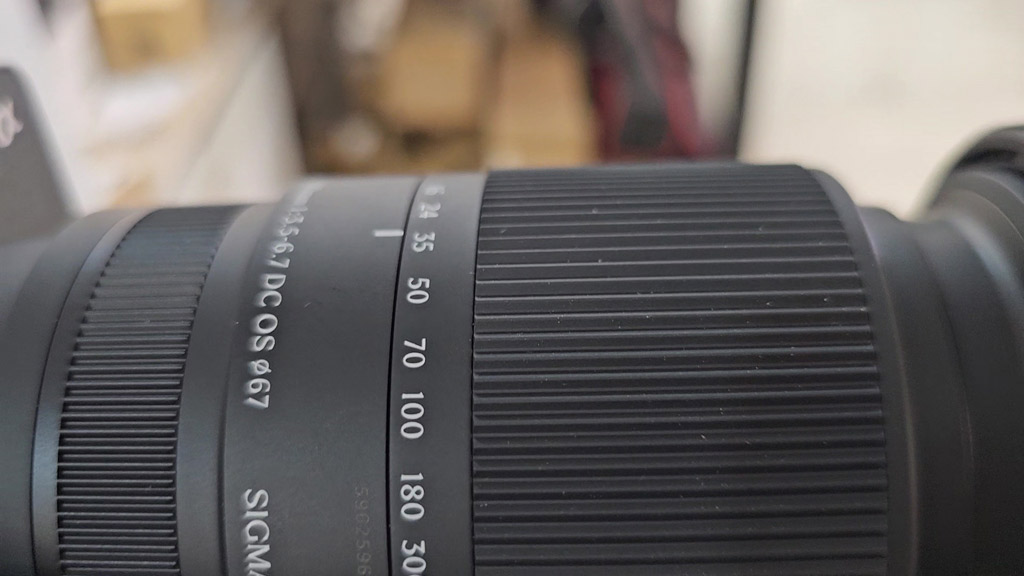
The zoom scale is marked at 16, 24, 35, 50, 70, 100, 180 and 300, and the ø67 mark tells you the filter size. There is a lock switch on the side of the barrel. Sigma describes it as a zoom lock at the wide end, which stops the lens from extending under its own weight when you carry it pointing down.
The hood and the front element
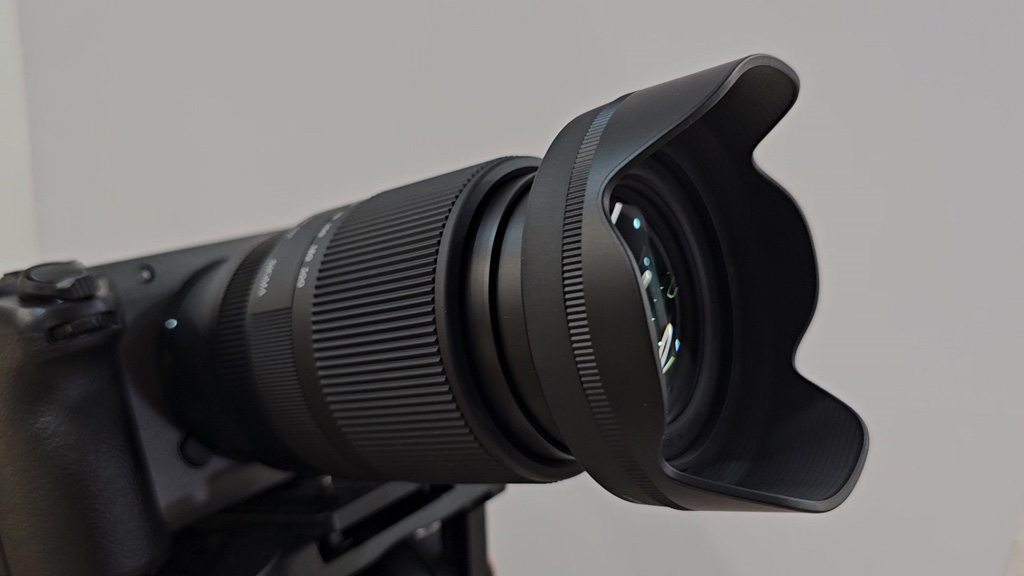
The supplied hood is a petal shape with a ribbed grip around the base. It twists on and reverses over the lens for storage.
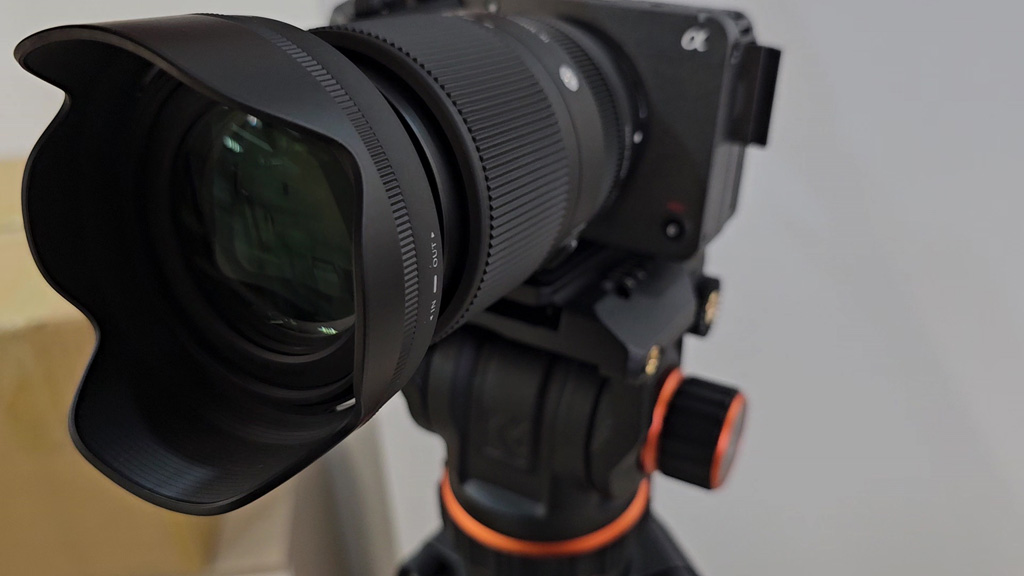
Behind the hood is the front element, with a 67mm filter thread around it. Sigma lists a water-repellent coating and a dust- and splash-resistant structure for this lens.
Which Cameras It Fits
Sigma makes this lens in five mounts. The glass is the same, but the length and weight change a little with the mount, so order the right one for your camera.
| Mount | Length | Weight |
|---|---|---|
| Sony E-mount | 123.4mm | 615 g |
| FUJIFILM X Mount | 123.7mm | 615 g |
| L-Mount | 121.4mm | 615 g |
| Canon RF Mount | 121.4mm | 625 g |
| Nikon Z mount | 125.4mm | 630 g |
All versions are 73.8mm in diameter. Ours is the Sony E-mount version. The lens is for the APS-C sensor format, which Sigma marks as “DC”. Sigma publishes a camera compatibility list, so check your exact body there.
The Big Features, Without the Jargon
What does an 18.8x zoom mean?
Divide the longest focal length by the shortest: 300 by 16 is about 18.8. At 16mm the lens sees a wide 83.2° view, enough for a landscape or a whole room. At 300mm it sees only 5.4°, which pulls a distant bird or player close. On most APS-C cameras that is roughly the view of a 24-450mm lens on a full-frame camera. That last figure is our own conversion, not a Sigma specification.
What does F3.5-6.7 mean?
It is how wide the lens opens, and the number changes as you zoom. At 16mm the widest setting is F3.5. At 300mm it is F6.7, which lets in much less light. In bright daylight this does not matter. Indoors or at dusk, the camera will raise the ISO or slow the shutter to make up for it. This is the main trade-off of any lens with this much range.
What does OS do?
OS is Sigma’s optical stabilizer. It moves glass inside the lens to cancel the shake of your hands. Sigma rates it at 6 stops at the wide end and 4.5 stops at the telephoto end, measured to CIPA guidelines, using its OS2 algorithm. In practice it lets you use slower shutter speeds by hand than you otherwise could. It steadies your hands, not a moving subject.
What is the HLA autofocus motor?
HLA stands for High-response Linear Actuator. Sigma says it gives fast, smooth and accurate autofocus, suited to moving subjects such as birds and aircraft.
How close can it focus?
The minimum focusing distance is 17 cm at the wide end and 105 cm at the telephoto end. The strongest close-up comes at 70mm, where the magnification ratio reaches 1:2. That means a subject appears on the sensor at half its real size, which is enough for flowers, insects, food and product details.
What about video?
Sigma lists suppressed focus breathing for this lens. Focus breathing is the small change in framing when focus moves from near to far. Less of it means steadier-looking focus pulls in video.
What is inside?
The optical design has 20 elements in 14 groups, including 1 FLD, 4 SLD and 4 aspherical elements. These special glass types are there to control colour fringing and distortion across the long zoom range. The aperture has 9 rounded blades.
Official Specifications
| Camera type | Mirrorless |
| Sensor format | APS-C (DC) |
| Mounts | L-Mount, Canon RF, FUJIFILM X, Nikon Z, Sony E-mount |
| Focal length | 16-300mm |
| Maximum aperture | F3.5-6.7 |
| Minimum aperture | F22-45 |
| Lens construction | 20 elements in 14 groups (1 FLD, 4 SLD, 4 aspherical) |
| Angle of view | 83.2° to 5.4° (Canon RF: 79.9° to 5.1°) |
| Diaphragm blades | 9, rounded |
| Minimum focusing distance | 17 cm (wide) to 105 cm (tele) |
| Maximum magnification | 1:2 at 70mm |
| Stabilization | 6 stops (wide), 4.5 stops (tele) |
| Autofocus motor | HLA (High-response Linear Actuator) |
| Filter size | 67mm |
| Size, Sony E-mount | 73.8mm × 123.4mm |
| Weight, Sony E-mount | 615 g |
| Edition number | C025 |
Source: Sigma, 16-300mm F3.5-6.7 DC OS Contemporary product page.
Pros and Cons
👍 WHAT WE LIKE
✔ Huge range. 16mm to 300mm in one lens.
✔ Light for what it does. 615 g in Sony E-mount.
✔ Stabilized. Up to 6 stops at the wide end.
✔ Real close-ups. 1:2 magnification at 70mm.
✔ Weather protection. Dust- and splash-resistant structure.
✔ Five mounts. Sony, Fujifilm, Canon, Nikon and L-Mount.
👎 WHAT TO KNOW
✘ F6.7 at 300mm. It needs good light at the long end.
✘ APS-C only. It is not made for full-frame sensors.
✘ Aperture changes with zoom. Exposure shifts as you zoom in.
✘ Long minimum distance at 300mm. 105 cm at the telephoto end.
✘ Mount-specific. You must order the right version.
Is the Sigma 16-300mm Right for You?
| If you are a… | Our view |
|---|---|
| Traveller with one camera bag | Yes. One lens covers the whole trip. |
| Parent at sports days and school events | Yes, outdoors. The reach and stabilization help. |
| Casual wildlife or bird photographer | Yes, in daylight. 300mm on APS-C reaches far. |
| Video shooter on an APS-C camera | Yes. Suppressed focus breathing and one lens for every shot. |
| Indoor or night shooter | Not as a main lens. A faster lens suits dim light better. |
| Full-frame camera owner | No. This lens is designed for APS-C. |
For smooth moving shots with a lens like this, see our DJI RS 4 review. For sound to go with the picture, see our RØDE Wireless PRO review.
Questions People Ask About the Sigma 16-300mm
Is the Sigma 16-300mm a full-frame lens?
No. It is an APS-C lens, marked DC by Sigma.
Which mounts is the Sigma 16-300mm available in?
L-Mount, Canon RF Mount, FUJIFILM X Mount, Nikon Z mount and Sony E-mount.
Does the Sigma 16-300mm have image stabilization?
Yes. Sigma rates the optical stabilizer at 6 stops at the wide end and 4.5 stops at the telephoto end.
How heavy is the Sigma 16-300mm?
615 g in Sony E-mount, FUJIFILM X Mount and L-Mount, 625 g in Canon RF Mount and 630 g in Nikon Z mount.
What filter size does it take?
67mm.
Can it shoot close-ups?
Yes. The maximum magnification ratio is 1:2 at 70mm, and it focuses as close as 17 cm at the wide end.
Is it weather sealed?
Sigma lists a dust- and splash-resistant structure and a water-repellent coating.
What comes in the box?
The lens, lens hood LH706-03, front cap, rear cap and a pouch.
The Bottom Line
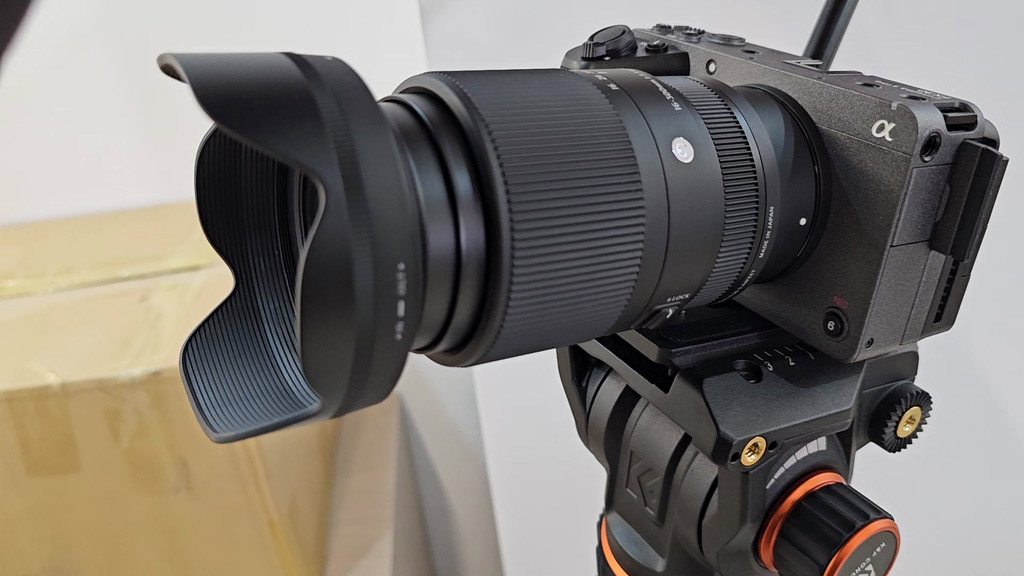
The Sigma 16-300mm F3.5-6.7 DC OS Contemporary is a lens about being ready. Wide, long and close are all there without opening the bag, in a body that weighs little more than a standard zoom, with stabilization and weather protection included. What you give up is light at the long end, where F6.7 asks for daylight or a higher ISO. If you want one lens to leave on an APS-C camera for travel, family and outdoor video, this is a strong choice. If most of your shooting is indoors or after dark, pair it with a faster lens, or choose that faster lens first.
SIGMA 16-300MM · APS-C
Sigma 16-300mm F3.5-6.7 DC OS Contemporary
✔ 18.8x zoom range ✔ Optical stabilization ✔ 1:2 close-ups
Price and stock change often. Pick the version for your camera mount before you order.

About the Author: Jason
I am a tech enthusiast and the reviewer behind Tech Buying Today. I unboxed this Sigma 16-300mm, mounted it on a Sony FX30 and photographed it myself, and the specifications in this review come from Sigma’s official product page. Before I recommend anything, I compare the specifications, read the fine print and look for the trade-offs, then write it up in plain language so you can decide quickly.
Learn more about Tech Buying Today and how we choose what to recommend.