
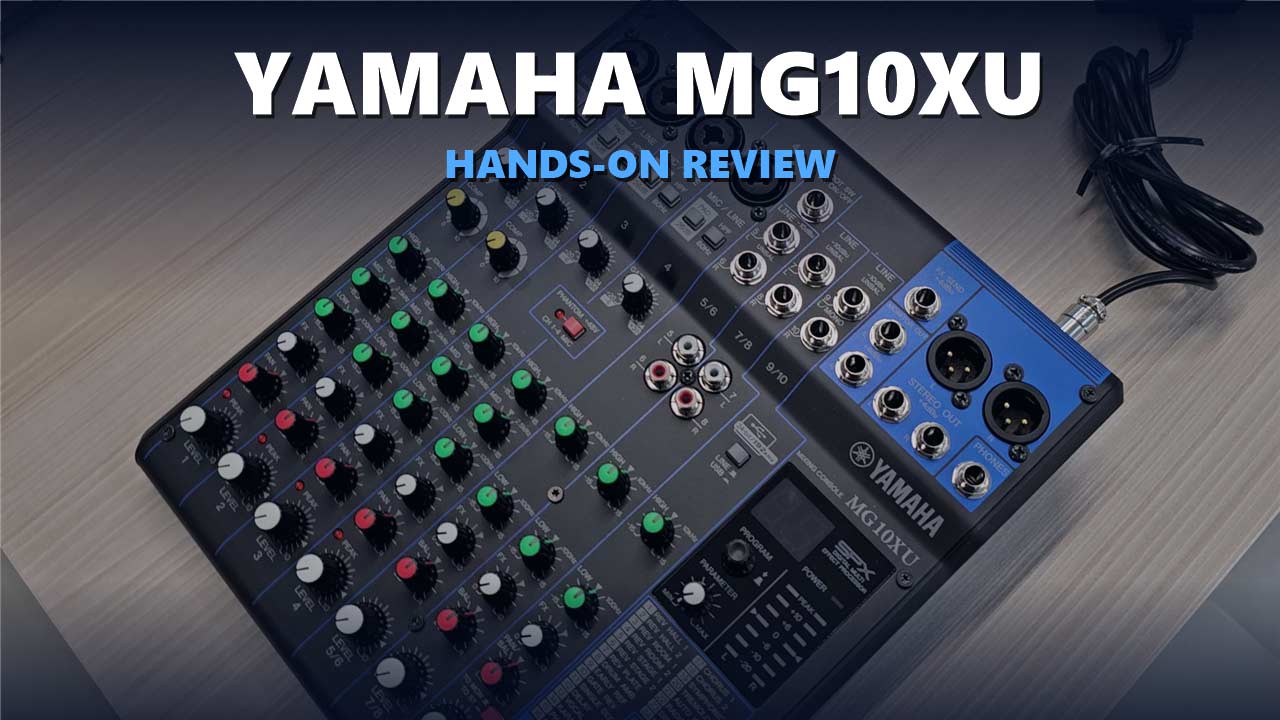

A small mixer is the centre of a podcast desk, a streaming setup or a small live rig. It has to take several microphones and instruments, let you balance them quickly, and send a clean signal to your speakers and your computer. The Yamaha MG10XU is one of the best-known compact mixers for that job: 10 channels, four microphone preamps, built-in effects and a USB audio connection in one box.
We unboxed the MG10XU and went over every panel by hand. This review covers what comes in the box, how the controls are laid out, what each section does, how it compares with the other MG mixers, and whether it is the right pick for you.
Key Takeaways
- What it is: the Yamaha MG10XU is a 10-channel analog mixing console with built-in SPX digital effects and a USB audio interface.
- Inputs: four mic/line combo inputs with phantom power, plus three stereo line pairs.
- Best for: podcasts with up to four microphones, live streaming, small bands, rehearsals and small venues.
- Main strengths: clean D-PRE preamps, one-knob compressors, 24 built-in effects and USB recording up to 24-bit/192 kHz.
- Main weaknesses: rotary level knobs instead of faders, a stereo-only USB feed and an external power adapter.
- Best alternative: the MG10XUF if you want faders, or the MG12XU if you need more microphone inputs.
Disclosure: This post contains affiliate links. If you buy through them, we may earn a commission at no extra cost to you.
Yamaha MG10XU Review: A Compact Mixer With Effects and USB
Quick Verdict
The MG10XU packs a lot into a small frame: four microphone inputs with phantom power, three stereo line channels, a 3-band EQ, compressors on the first two channels, 24 SPX effects and a USB connection for recording or streaming. The trade-offs are rotary knobs instead of faders and a USB feed that carries only the stereo mix. If you need a dependable small mixer for voice and music, it is an easy recommendation.
- Best for: podcasting, live streaming, small gigs, rehearsals, church and school use
- Not for: multitrack recording of every channel, or setups with more than four microphones

YAMAHA MG10XU
Yamaha MG10XU 10-Channel Mixing Console
✔ 4 mic inputs with phantom power ✔ Built-in SPX effects ✔ USB audio
Price and stock change often. The button shows today’s price on Amazon.
📋 Key Specifications
| Type | 10-channel analog mixing console |
| Microphone inputs | 4 (XLR/TRS combo, D-PRE preamps) |
| Line inputs | 10 in total (4 mono, 3 stereo pairs) |
| Phantom power | +48 V |
| Input switches | 26 dB PAD and 80 Hz high-pass filter on channels 1 to 4 |
| Compressor | One-knob compressor on channels 1 and 2 |
| EQ | 3-band on the mono channels |
| Effects | SPX digital multi-effect processor, 24 programs |
| USB audio | USB 2.0, 2 in / 2 out, up to 24-bit/192 kHz |
| Outputs | Stereo out (XLR and 1/4 inch), monitor out, FX send, headphones |
| Level controls | Rotary knobs |
| Power | External AC adapter (included) |
| Size | 244 × 71 × 294 mm (W × H × D) |
| Weight | 2.1 kg |
📦 What’s in the Box
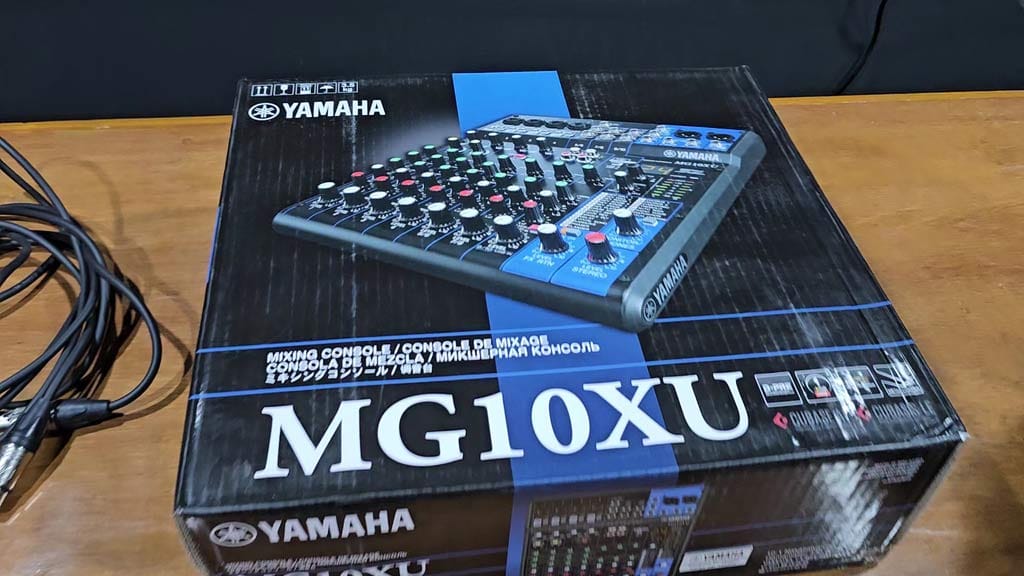
The MG10XU arrives in a printed retail box with the mixer held between two foam blocks. Inside, the package is simple:
- Yamaha MG10XU mixing console
- AC power adapter
- Owner’s manual and technical specifications
- Cubase AI download information
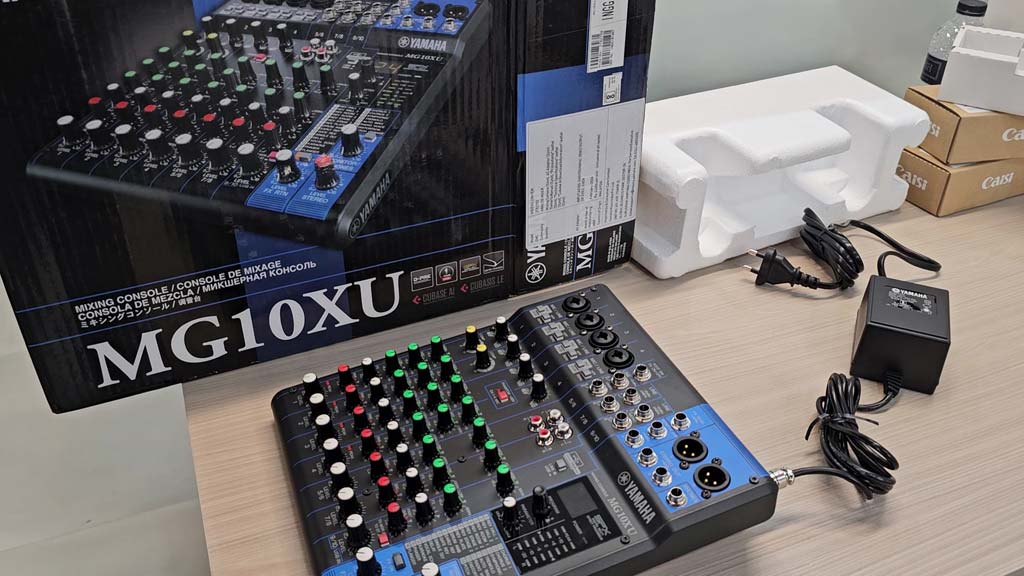
There is no USB cable and there are no audio cables in the box, so plan for a USB-B cable and the XLR or 1/4 inch cables your setup needs.
🎛️ Design and Layout
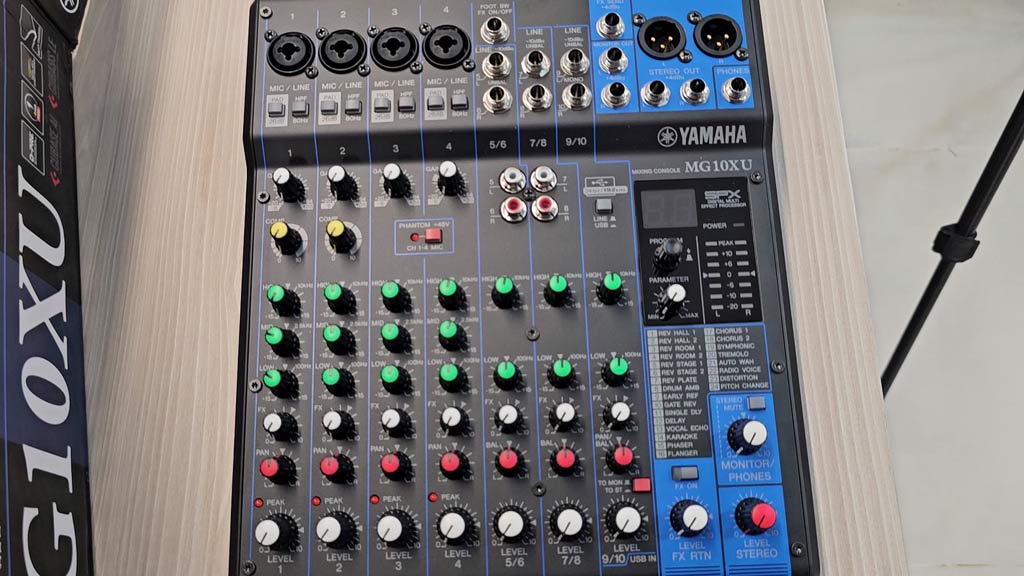
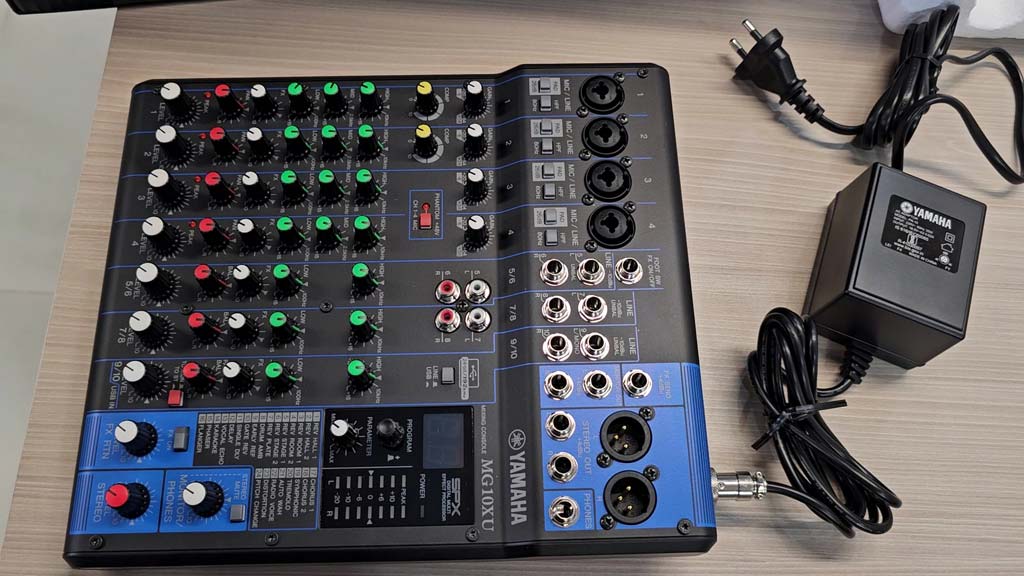
The MG10XU uses the familiar MG-Series look: a dark metal body with a blue master section on the right. Every connection is on the top panel, so you can see and reach each cable without turning the mixer around. The controls run in straight columns, one per channel, and the knob caps are colour-coded: white for level, green for EQ and red for pan and the FX send.
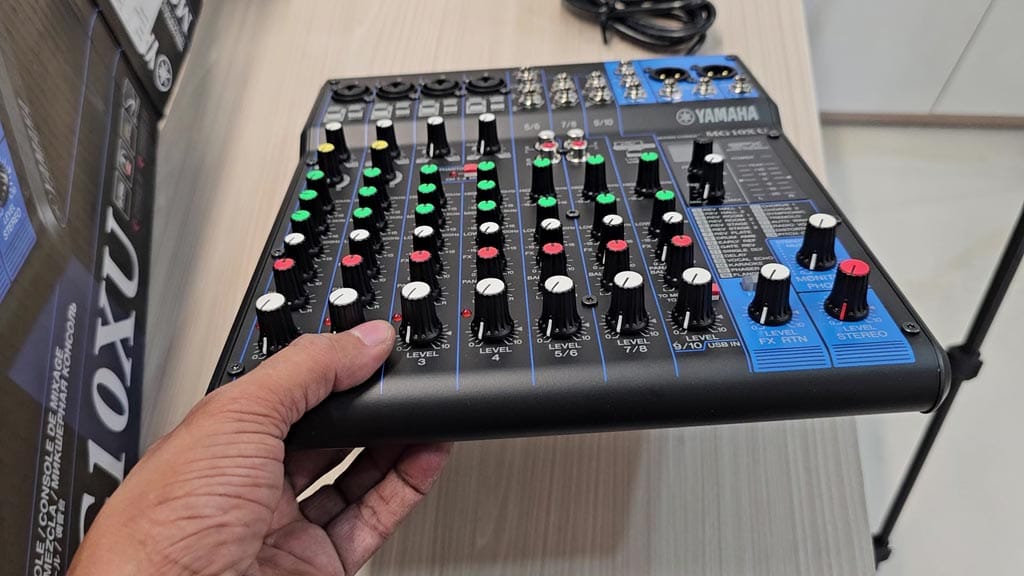
It is small enough to lift with one hand and takes up about the space of a sheet of paper on a desk. At 2.1 kg it stays in place when you plug cables in, but it is still easy to carry to a gig.
🎤 Inputs and Microphone Preamps
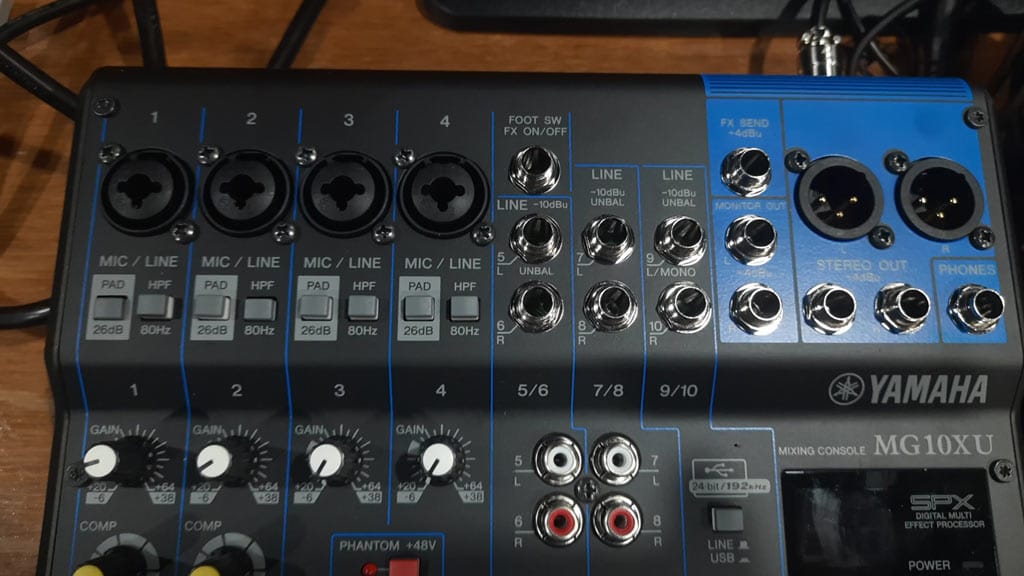
Channels 1 to 4 have combo sockets that accept either an XLR microphone cable or a 1/4 inch plug. Each has its own gain knob, a 26 dB PAD switch for loud sources and an 80 Hz high-pass filter that cuts rumble and handling noise. A single switch turns on +48 V phantom power for condenser microphones.
These four channels use Yamaha’s D-PRE preamps, the same design found in the brand’s larger consoles. Channels 5/6, 7/8 and 9/10 are stereo line pairs for keyboards, playback devices or a computer. Channels 5/6 and 7/8 also have RCA sockets, which is handy for a phone or media player.
🎚️ EQ, Compressor and Level Controls
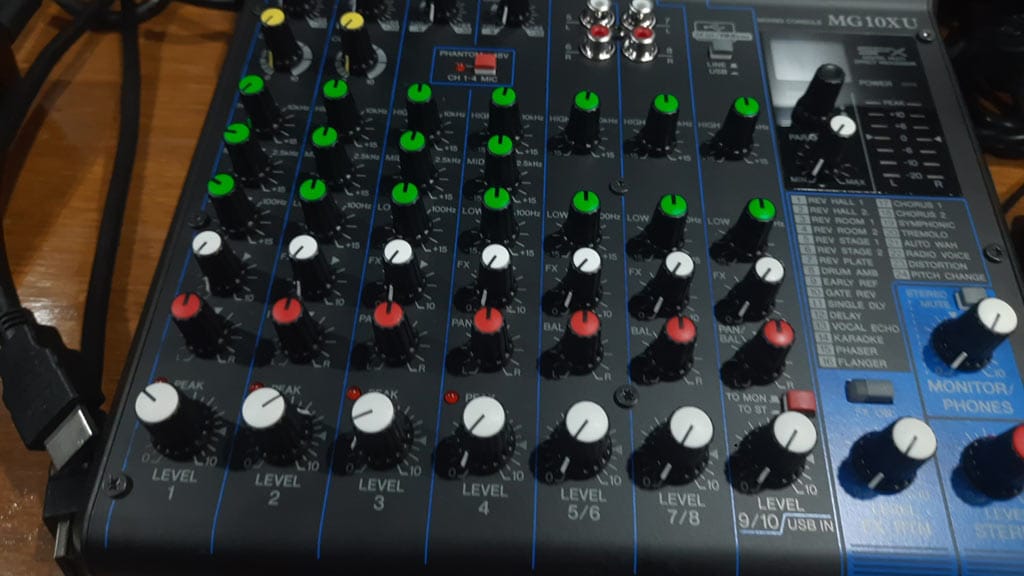
Channels 1 and 2 each have a one-knob compressor. Turn it up and it evens out a voice or a bass guitar without any other settings to learn, which is a real help for beginners. The mono channels have a 3-band EQ with high, mid and low controls, followed by an FX send, a pan control and the level knob.
The level controls are rotary knobs, not faders. They save space and keep the mixer small, but they are slower to adjust on the fly than faders, and it is harder to see your mix at a glance. If that matters to you, the MG10XUF is the same mixer with faders.
✨ SPX Effects
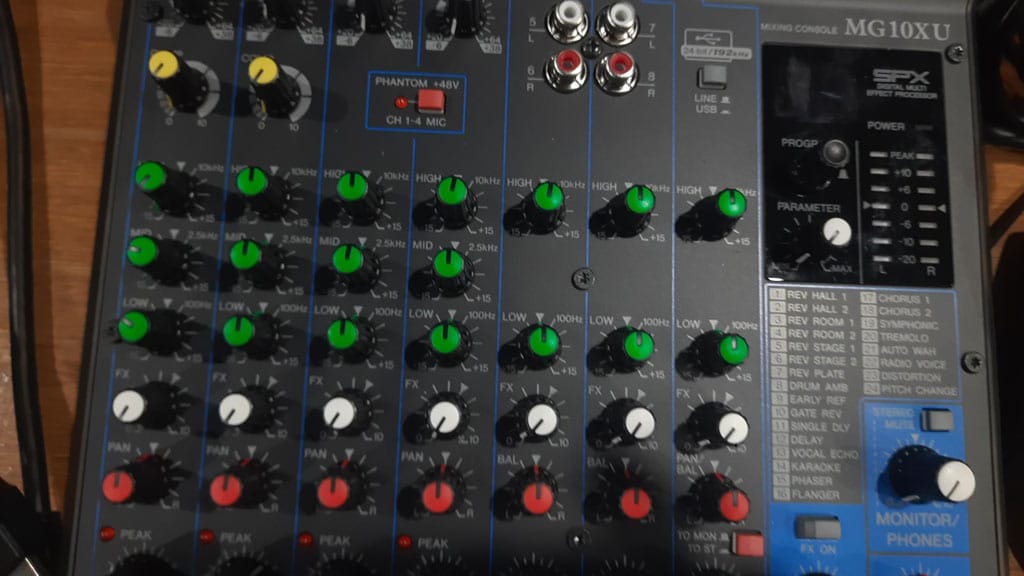
The “X” in the name stands for the built-in SPX digital multi-effect processor. It offers 24 programs, including reverbs, delays, chorus and other modulation effects, and the full list is printed on the panel next to the selector. You choose a program with one knob, set its main parameter with another, and then decide how much of each channel goes to the effect with the red FX knobs.
There is also a footswitch socket to turn the effects on and off, which is useful for singers who want reverb during a song and a dry voice between songs.
🔌 USB Audio and Power
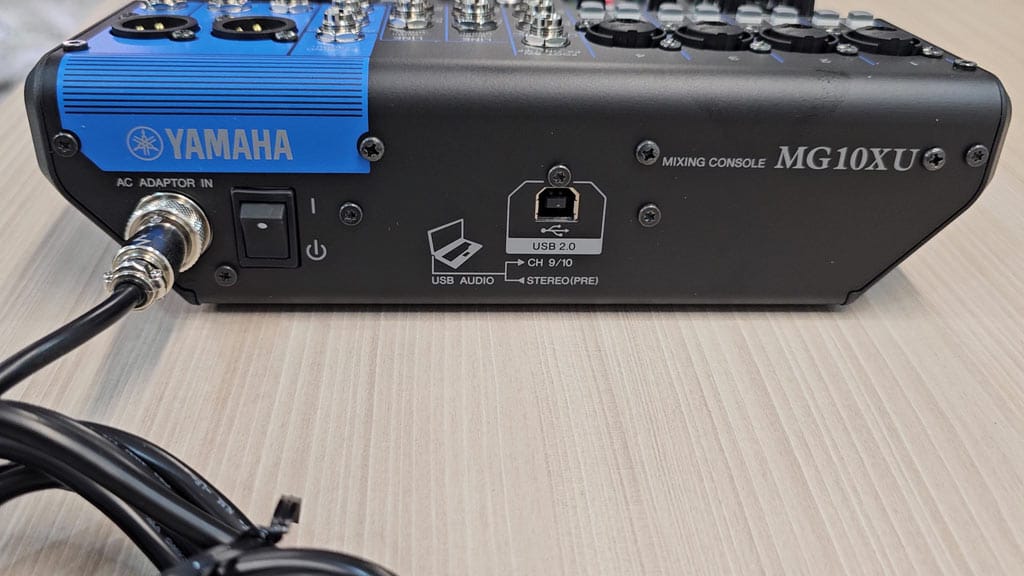
The “U” stands for USB. The USB 2.0 port on the back turns the mixer into a 2-in / 2-out audio interface that works at up to 24-bit/192 kHz. It sends the stereo mix to your computer for recording or streaming, and it brings computer audio back into the mixer on channel 9/10 or straight to the stereo bus.
The key limit is that USB carries only the stereo mix. You cannot record each microphone to its own track, so the balance you set on the mixer is the balance you get in the recording.
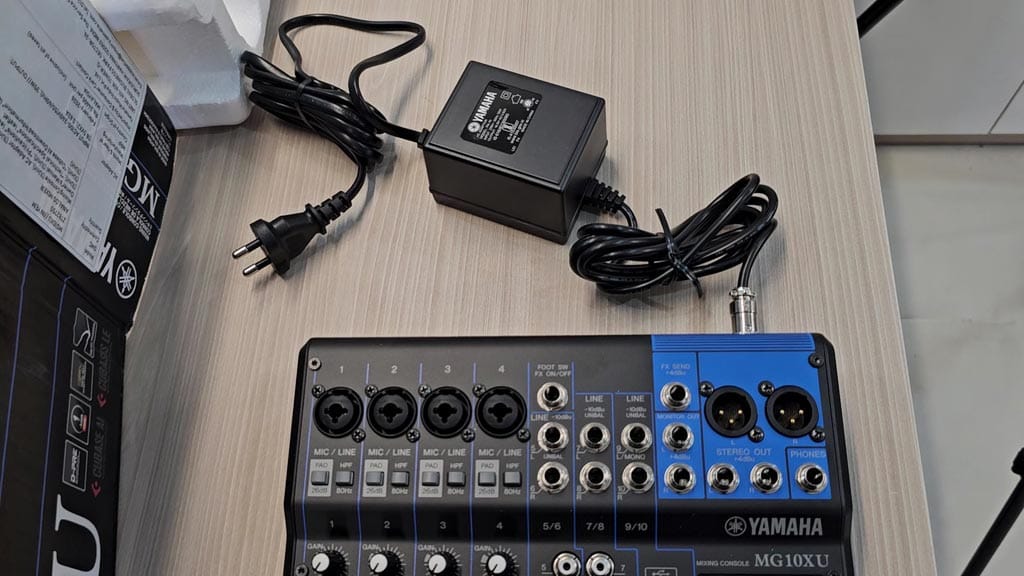
Power comes from an external AC adapter with a locking screw connector, so it cannot be pulled out by accident. The power switch is on the back panel next to it. The adapter is fairly large, so leave room for it on your power strip.
🎧 Outputs and Monitoring
The main stereo output is available on both XLR and 1/4 inch sockets, so it connects to powered speakers, an amplifier or a recorder without adapters. A separate monitor output feeds studio monitors, and the headphone socket has its own level control. For monitoring a podcast or a stream, a closed-back studio headphone such as the one in our Audio-Technica ATH-M30x review plugs straight into this socket with its 6.3 mm adapter.
Pros and Cons
The strengths and the trade-offs of the Yamaha MG10XU at a glance
👍 WHAT WE LIKE
✔ Four mic inputs. Each has phantom power, a PAD switch and a high-pass filter.
✔ One-knob compressors. Channels 1 and 2 even out voices with a single control.
✔ 24 SPX effects. Reverbs and delays are built in, with footswitch control.
✔ USB audio. Record or stream at up to 24-bit/192 kHz with one cable.
✔ Flexible outputs. The main mix comes out on both XLR and 1/4 inch sockets.
✔ Compact body. A metal case with every socket on the top panel.
👎 WHAT TO KNOW
✘ No faders. Levels are set with rotary knobs.
✘ Stereo-only USB. It sends the finished mix, not separate tracks.
✘ No mute buttons. You turn a channel down to silence it.
✘ Bulky power adapter. It is external and takes space on a power strip.
✘ No USB cable. You need to supply your own.
In short: strong on inputs, effects and USB. The main compromise is knobs instead of faders.
⚠️ Common Complaints About the MG10XU
- No faders. Knobs are harder to ride during a live show. Buyers who mix live often choose the MG10XUF for this reason.
- Stereo-only USB. People who expect multitrack recording are disappointed. For separate tracks you need a multitrack interface or mixer.
- No channel mutes. To silence a channel you have to turn its level knob down and then find the same position again.
⚖️ MG10XU vs MG10 vs MG10X vs MG10XUF vs MG12XU
| Model | Mic inputs | Effects and USB | Level controls |
|---|---|---|---|
| MG10 (10-channel) | 4 | Neither | Knobs |
| MG10X (10-channel) | 4 | Effects only | Knobs |
| MG10XU (10-channel) | 4 | Effects and USB | Knobs |
| MG10XUF (10-channel) | 4 | Effects and USB | Faders |
| MG12XU (12-channel) | 6 | Effects and USB | Faders |
Quick Comparison Takeaway
- Choose the MG10 if you only need a simple analog mixer with no effects and no USB.
- Choose the MG10X if you want effects for live sound but never record to a computer.
- Choose the MG10XU if you want effects and USB in the smallest body.
- Choose the MG10XUF if you want the same features with faders.
- Choose the MG12XU if you need six microphone inputs.
Who Should Buy the MG10XU?
- Podcasters with two to four microphones
- Streamers who want one mix sent to the computer over USB
- Solo performers and small bands
- Schools, churches and meeting rooms
Who Should Skip It?
- Anyone who needs each channel on its own track
- Live engineers who prefer faders
- Groups with more than four microphones
❓ Frequently Asked Questions
Can the Yamaha MG10XU record multitrack over USB?
No. USB carries only the stereo mix, as 2 channels in and 2 channels out.
Does the MG10XU have phantom power?
Yes. One switch supplies +48 V phantom power to the microphone inputs for condenser microphones.
What is the difference between the MG10XU and the MG10X?
The MG10XU adds a USB audio interface. Both have the SPX effects.
Does the MG10XU have faders?
No. It uses rotary level knobs. The MG10XUF is the version with faders.
How many microphones can you connect to the MG10XU?
Four, on channels 1 to 4.
Is the Yamaha MG10XU good for podcasting and streaming?
Yes, for up to four microphones. It sends one finished stereo mix to your computer over USB.
Related Reviews and Guides
- Audio-Technica ATH-M30x Review – a budget studio headphone for monitoring your mix
- Best Over the Ear Headphones Wired – more wired headphones for desk and studio use
- How to Choose the Right Headphones – a buying guide for every use
✅ Bottom Line
The Yamaha MG10XU covers what most small setups need: four good microphone inputs, simple compression, usable effects and a USB connection, all in a body that fits on any desk. If you can live with knobs instead of faders and a stereo USB feed, it is one of the safest small mixers to buy. If you want faders, pick the MG10XUF, and if you need more microphones, step up to the MG12XU.
YAMAHA MG10XU
Yamaha MG10XU 10-Channel Mixing Console
✔ 4 mic inputs with phantom power ✔ Built-in SPX effects ✔ USB audio
Price and stock change often. The button shows today’s price on Amazon.

About the Author: Jason
I am a tech enthusiast and the reviewer behind Tech Buying Today. I unboxed and photographed this Yamaha MG10XU myself, and the hands-on photos in this review are my own. Before I recommend anything, I compare the specifications, read the fine print and look for the trade-offs, then write it up in plain language so you can decide quickly.
Learn more about Tech Buying Today and how we choose what to recommend.