

Wi-Fi 8 is already showing up in products, even though the standard is not finished. TP-Link opened pre-orders for its first Wi-Fi 8 router on September 30, 2026, and a fiber provider showed a Wi-Fi 8 gateway in mid October.
However, the headline number may surprise you, because Wi-Fi 8 is not built to be faster than Wi-Fi 7 at the top end. It is built to be steadier. So here is what actually changes, when you can buy it, and whether waiting makes sense for your home.
Key Takeaways
- Same top speed: Wi-Fi 8 keeps the same 46 Gbps theoretical maximum as Wi-Fi 7. The goal is steadier connections instead.
- Still a draft: the IEEE standard behind it, 802.11bn, is planned for final approval in 2028, so early products use a draft.
- Where it helps most: busy homes, several access points and moving between rooms, rather than one speed test next to the router.
- Pre-orders in some regions: TP-Link lists the UK, Germany, Australia and Canada. The United States is not on that list yet.
- Most people should not wait: a good Wi-Fi 7 router is the better buy today. Waiting only makes sense for a big mesh upgrade.
Disclosure: This post links to guides that contain affiliate links. If you buy through them, we may earn a commission at no extra cost to you.
How we researched this
- I read the IEEE task group page for the standard, then the pages TP-Link and Qualcomm published about their first Wi-Fi 8 products.
- Where a number comes from a company, the post says so. Those figures come from the companies’ own tests, not from independent reviews.
- Nothing here was lab-tested by us, because Wi-Fi 8 gear has not reached our desk. The post is based on the standard’s documents and company announcements.
- Where sources disagree or stay silent, I say so instead of guessing. Prices are left out because they change often.
Last updated: October 21, 2026
What Is Wi-Fi 8?
Wi-Fi 8 is the name for the next Wi-Fi generation after Wi-Fi 7. Its technical name is IEEE 802.11bn, and the project calls itself “Ultra High Reliability.” That name tells you the plan, because the work is about fewer drops and steadier speeds instead of bigger peak numbers.
Think about how your Wi-Fi fails today. A video call freezes when someone starts a download, or your phone clings to a weak router while you walk upstairs. Those problems rarely come from a lack of top speed. As a result, Wi-Fi 8 aims at crowded airwaves, weak signals at the edge of the house and handoffs between routers.
The standard also has to work with older gear. The IEEE project says Wi-Fi 8 must stay compatible with devices that use the 2.4, 5 and 6 GHz bands today, so your current phones and laptops will still connect.
Wi-Fi 8 vs Wi-Fi 7: What Really Changes
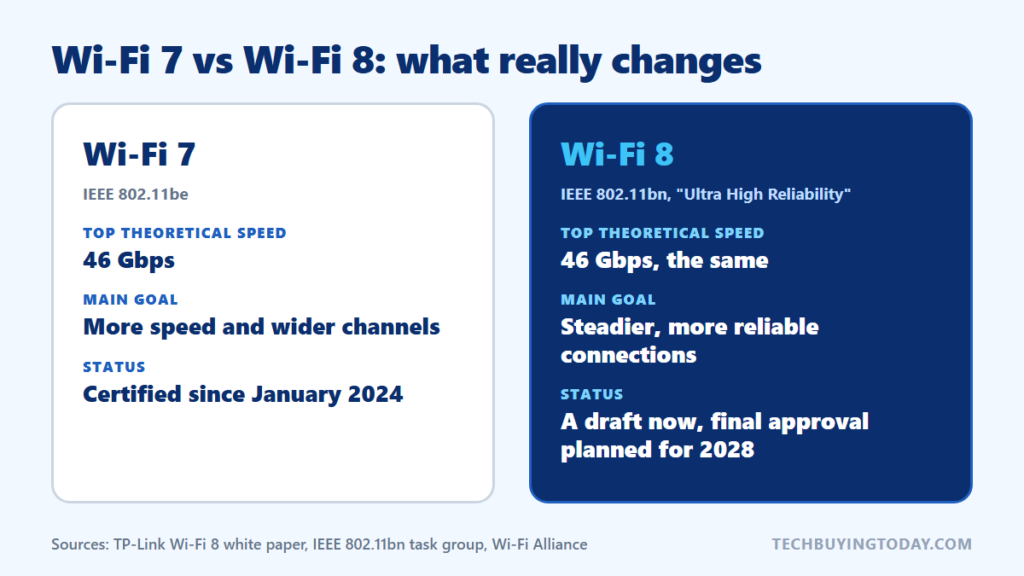
| Compared | Wi-Fi 7 | Wi-Fi 8 |
| Standard | IEEE 802.11be | IEEE 802.11bn |
| Top theoretical speed | 46 Gbps | 46 Gbps (the same) |
| Main goal | More speed, wider channels | Steadier, more reliable connections |
| Status | Wi-Fi Alliance certification started January 2024 | Draft standard, final approval planned for 2028 |
| Best moment to notice it | Fast wired internet and fast devices | Busy homes, weak spots and several routers |
The 46 Gbps figure is a lab ceiling that no home connection reaches, so it was never the number that decides your day. Still, the IEEE sets measurable targets for the new standard. The task group’s goals say at least one operating mode should cut lost data packets by 25 percent, at least one should cut the slowest delays by 25 percent, and at least one should raise throughput by 25 percent at some signal levels, all compared with Wi-Fi 7. Those are goals for the standard, though, not results from real routers.
The Wi-Fi 8 Features in Plain English
Wi-Fi 8 adds several technologies with long names. Most of them solve one of four everyday problems, so I grouped them that way. The names come from the TP-Link white paper, which is the most detailed public explanation so far.
- Routers that work together. Multi-AP coordination lets nearby routers or mesh nodes plan who talks when, instead of shouting over each other. TP-Link lists coordinated beamforming, spatial reuse and scheduling as part of this.
- Smoother moving around. Wi-Fi 8 aims at seamless roaming. The idea is that your phone connects to the next node before leaving the old one, so a call does not stutter in the hallway.
- Better use of busy channels. Non-primary channel access and dynamic sub-band operation let a router use spare parts of a channel when the main one is crowded.
- Stronger signals from far away. Enhanced long range and distributed resource units help weak devices, like a camera at the edge of the yard, send data back to the router.
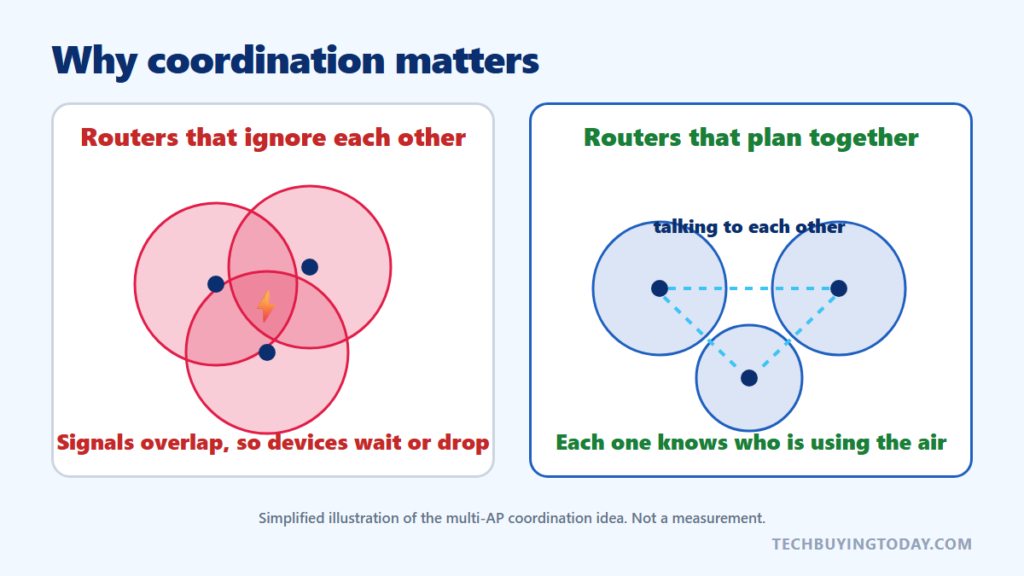
Coordination is the feature to watch if you use a mesh system. Today, mesh nodes in a large home often compete for the same airtime. With Wi-Fi 8, however, they are meant to share it on purpose, which is why the benefit should show up in homes with several nodes more than in a small apartment with one router.
When Can You Actually Buy Wi-Fi 8?
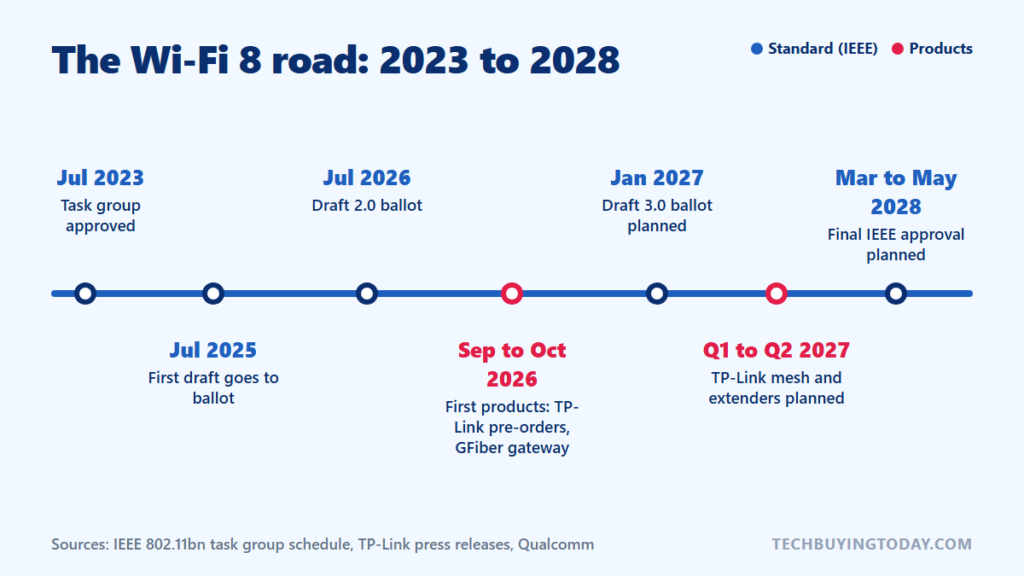
Products are ahead of the standard, which is unusual. The IEEE schedule shows the second draft going to ballot in July 2026, a third draft planned for January 2027 and final approval planned for 2028. Meanwhile, companies are already shipping hardware built on the draft.
| Product | Status as of October 21, 2026 | What to know |
| TP-Link Archer 8 Ultra (router, Broadcom chip) | Pre-orders opened September 30 in select regions | Tri-band, rated 19 Gbps combined wireless, two 10 Gbps ports and four 2.5 Gbps ports. TP-Link says some features arrive later by update. |
| TP-Link Deco 8 Ultra (mesh) | Announced, listed as upcoming | TP-Link also plans more Wi-Fi 8 mesh, a travel router and range extenders for 2027. |
| 20 Gig fiber gateway (GFiber, Qualcomm and Gemtek) | Shown at Network X in October 2026 | Quad-band. Reports say customers on the 20 Gig plan get it first. |
In the United States, I could not find a Wi-Fi 8 router you can order yet. TP-Link’s announcement names the UK, Germany, Australia and Canada for pre-orders and then says “and more.” Also, the Wi-Fi Alliance, which runs the Wi-Fi certification program, had not announced a Wi-Fi 8 program in anything I could reach. Wi-Fi 7 started its program in January 2024, so a Wi-Fi 8 program will probably come later, closer to the final standard. In addition, Qualcomm’s own brief for one of its Wi-Fi 8 platforms describes its 802.11bn support as based on the draft, which is a useful reminder that early products are a bet on the final rules.
Claimed vs Realistic: Reading the Wi-Fi 8 Hype
Early Wi-Fi 8 marketing uses big words, so a quick translation helps. This table puts the claim next to what the sources actually support.
| You will hear | What the sources support |
| “Faster than Wi-Fi 7” | Top theoretical speed is the same, 46 Gbps. TP-Link claims up to 33 percent more consistent throughput at mid to long range and up to 24 percent more under interference, from its own controlled tests. |
| “Lower latency” | The IEEE targets a 25 percent cut in the slowest delays in at least one mode. TP-Link says latency is lower but gives no number. Independent tests are not out yet. |
| “Works with all my devices” | The IEEE says the standard must coexist with older devices. TP-Link’s pages do not say which features need Wi-Fi 8 phones or laptops, so I could not confirm that. |
| “Available now” | Only in some regions, and not yet in the United States as far as I could find. Several features arrive later through firmware updates. |
| “The final standard” | It is a draft. Final approval is planned for 2028, so early routers could need updates to match it. |
Do You Need New Devices to Use Wi-Fi 8?
Probably not to connect, but maybe to get the full benefit. Your current phone, TV and laptop should still join a Wi-Fi 8 router, because the standard has to stay compatible. However, some features, like multi-AP coordination, mainly work between the routers themselves, while others may need a Wi-Fi 8 device on the other end.
Companies have not published a clear list of which is which. So treat any promise that Wi-Fi 8 will fix your old devices with caution. Most homes still run many Wi-Fi 5 and Wi-Fi 6 devices, and those will not gain anything from a new router’s newest tricks.
Should You Wait for Wi-Fi 8?
For most households, no. A Wi-Fi 7 router already covers fast plans and many devices, and it usually costs less than first-generation Wi-Fi 8 gear. Here is how I would decide, depending on your situation.
Buy Now or Wait: A Quick Guide
| Your situation | My advice | Why |
| Your router is old or failing | Buy Wi-Fi 7 now | Waiting leaves you with weak Wi-Fi in the meantime, and Wi-Fi 8 is not on US shelves yet. |
| One router in a small home | Wi-Fi 6 or 7 is plenty | Wi-Fi 8’s coordination features matter most with several routers. |
| Large home with a mesh system | Consider waiting a few months | Multi-AP coordination is the headline feature. Mesh and extender versions are planned for 2027. |
| Fast fiber, 10 Gbps or more | Wi-Fi 7 now, or an early adopter box if you like tinkering | Expect firmware updates, because the standard is still a draft. |
| Online gaming | Use Ethernet, then Wi-Fi 7 | A cable is steadier than any Wi-Fi today, and Wi-Fi 8 latency claims are untested. |
| Wi-Fi 6 works fine for you | Keep it | Nothing here fixes a problem you do not have. |
That table is a rule of thumb, not a spec. The honest answer changes if prices drop quickly or if independent tests show large gains.
Not Ready to Wait? Start With Wi-Fi 7
If your Wi-Fi needs fixing this month, Wi-Fi 7 is the sweet spot between old and next. These guides already compare the products for you, so you do not have to chase draft-standard gear.
- Want one strong router? Compare the best 6GHz WiFi routers built on Wi-Fi 7.
- Need whole-home coverage? See the best WiFi 7 mesh systems.
- Thinking about a flagship mesh? Read the NETGEAR Orbi 970 review first.
- Many devices at home? The best WiFi router for multiple devices guide covers that.
- Just a dead zone? A WiFi 7 extender can be the cheaper fix.
Wi-Fi 8 FAQ
Is Wi-Fi 8 faster than Wi-Fi 7?
Not at the top end. Both have a 46 Gbps theoretical maximum. Wi-Fi 8 aims to hold speeds steadier in busy or weak-signal situations.
What does 802.11bn mean?
It is the technical name of the Wi-Fi 8 standard. The IEEE names its Wi-Fi amendments with letter codes, and this project is also called Ultra High Reliability.
When will Wi-Fi 8 reach the United States?
I could not find a US listing for a Wi-Fi 8 router. TP-Link says more regions will follow, so check its US site and the router’s product page before you order.
Will my Wi-Fi 7 router work with Wi-Fi 8 devices?
The standard is meant to stay compatible with older gear, so devices should still connect. You would just not get the newest features from the old router.
Is it smart to buy first-generation Wi-Fi 8 gear?
Only if you want to be early. The standard is still a draft, and TP-Link says some features come later by update.
Final Recommendation
Overall, Wi-Fi 8 is a real step forward, but it is a step in reliability, not in top speed. If your Wi-Fi works, keep it. If you need a new router now, buy Wi-Fi 7 and skip the draft-standard gear. However, if you plan a large mesh system, then it is worth watching the 2027 Wi-Fi 8 mesh launches before you spend. Finally, wait for independent tests before you believe any percentage you read in a press release.
More Guides for Your Network
- Gamers can start with the best WiFi router for gaming picks.
- Anyone shopping for a travel setup or an extender can look at the WiFi 7 extender guide.
- For a premium mesh, there is also the best WiFi 7 mesh system list.
Sources
- IEEE 802.11 TGbn: task group update (scope, goals, schedule)
- White paper: TP-Link on Wi-Fi 8
- Archer 8 Ultra pre-order announcement (TP-Link)
- Wi-Fi 8 lineup shown at IFA 2026 (TP-Link)
- Plain-language Wi-Fi 8 page (TP-Link)
- Qualcomm: GFiber, Qualcomm and Gemtek Wi-Fi 8 gateway
- Wi-Fi Alliance: Wi-Fi CERTIFIED 7 introduced