


Here’s a situation that happens more than you’d think someone’s outdoor security camera goes offline in the middle of a storm, and the reason isn’t the camera. It’s that there’s no way to get WiFi out there without running wires. If you’ve got a backyard that’s too big, a barn that’s too far, a cabin that’s off-grid, or a workshop tucked around the corner, you already know the frustration. A solar powered WiFi extender is the fix it pulls your existing signal and pushes it out to where you actually need it, powered entirely by the sun.
No outlets. No electrician. No digging trenches for cable. You mount it, point it at the sun, and it runs day and night on its built-in battery. These are designed for the places where a regular plug-in extender simply can’t go farms, ranches, RV sites, remote cabins, garden sheds. If your outdoor WiFi problem has felt unsolvable, one of these two picks is probably the answer.
Last updated: October 2026. Pricing and availability checked, product picks updated.
What to Think About Before You Buy
Most people who end up with the wrong solar extender made one of a few simple mistakes. They grabbed the first thing that came up in search, picked one with a battery too small to last through a cloudy night, or bought something rated for indoor use that couldn’t survive a week outdoors. It’s worth taking two minutes to get this right before you spend the money.
The most common complaints from buyers who got burned:
- The battery died overnight because the solar panel was too small to keep up
- The unit stopped working after the first rainstorm no real weatherproofing
- Range claims on the box were way off once walls and trees got in the way
- Paid extra for 5GHz when 2.4GHz actually travels further outdoors
The two picks in this guide avoid all of those problems. Both have 15W or better solar panels, batteries in the 26,000–27,000mAh range that can handle a full cloudy day and still run through the night, genuine IP66 waterproofing, and 2.4GHz coverage that’s actually built for outdoor distance. Setup is straightforward on both if you can connect a router, you can set these up.
This guide is for homeowners with dead zones beyond the back door, rural folks covering barns or outbuildings, anyone running outdoor security cameras far from a power outlet, RV users who need camp WiFi without wires, and off-grid cabin owners who just want a signal that actually works.
Quick Comparison Solar Powered WiFi Extenders
| Rank & Model | Solar Panel & Battery | Range & Waterproof | Best For |
|---|---|---|---|
| #1 AQUZO E8 | 15W Solar + 27,000mAh | Up to 200 ft, IP66 | Yards, farms, RV, cameras |
| #2 AQUZO E6 | 12W Solar + 27,000mAh | Up to 200 ft, IP66 | Smaller yards, easy install |
Our Top Solar WiFi Extender Picks for 2026
Disclosure: This post contains affiliate links. As an Amazon Associate I earn from qualifying purchases. If you purchase through our links, we may earn a small commission at no extra cost to you.
Both of these were picked based on what actually matters for outdoor solar WiFi battery life, panel strength, weatherproofing, and signal reach. Not what looks good on a spec sheet.
#1 AQUZO E8 The One We’d Actually Buy First
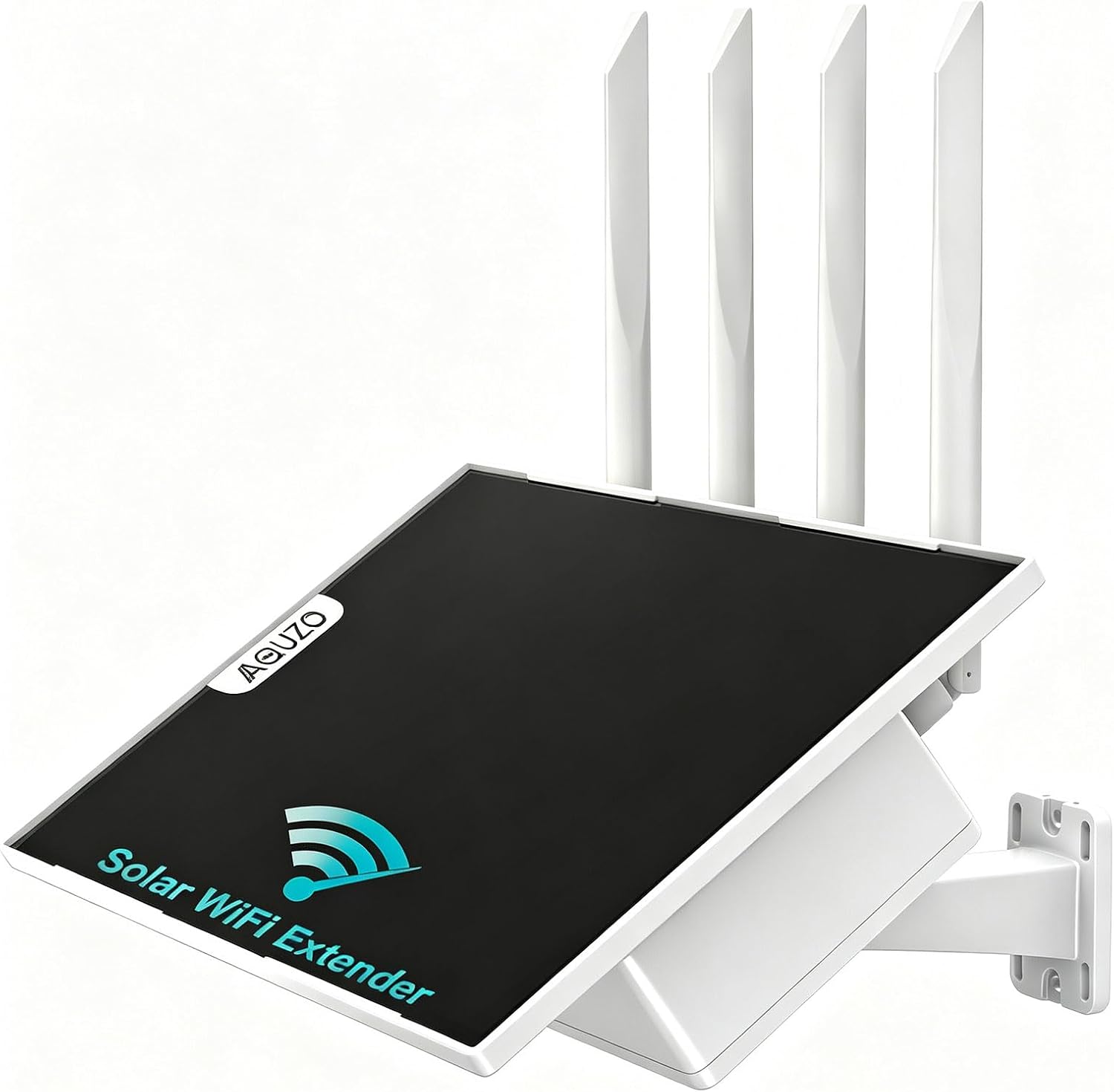
If you’ve got a standard backyard, a small farm, an RV site, or outdoor cameras that need reliable WiFi, the AQUZO E8 is the one to get. It’s got a 15W solar panel, a massive 27,000mAh battery that’s bigger than anything else in this price range, four antennas instead of the usual one or two, and IP66 waterproofing that can handle whatever the weather throws at it. It runs completely wire-free and stays on through the night and through overcast days without breaking a sweat.
The detail that genuinely separates it from the competition is the dual USB-C solar input. Most solar extenders give you one panel and that’s it. The E8 lets you plug in a second solar panel if your winter sun is weak or your mounting spot doesn’t get full-day exposure. That’s a practical feature you’ll actually use, not just a spec to put on the box. Setup is easy works with any standard 2.4GHz router, no special configuration required.
Best deal today. Prices may change.
Key Specs: 15W solar panel | 27,000mAh battery | 4 antennas | 2.4GHz 300 Mbps | IP66 waterproof | Up to 200 ft coverage | Dual USB-C solar input | Works with any standard router
What we like: That 27,000mAh battery is genuinely impressive for this category most competitors are sitting at 20,000mAh or less. Four antennas mean the signal spreads properly instead of just pointing in one direction. The IP66 rating means rain, dust, heat, and cold aren’t going to kill it. And the dual solar input is something you’ll be glad exists when December rolls around and the sun angle drops. Over 100 people buy this on Amazon every month, which tells you it’s actually being used, not just listed.
Worth knowing: The 200 ft range is solid for most yards and small farms, but if you’re trying to reach something genuinely far away a barn at the other end of the property, an outbuilding 400 ft out you’ll want the second pick below instead. And like all solar extenders in this category, it runs on 2.4GHz only, which is actually the right call for outdoor distance but won’t give you 5GHz speeds.
Best For: Homeowners | Farm and ranch owners | RV and camping setups | Outdoor security cameras | Gardens and patios | Off-grid cabins | Barns and workshops within 200 ft
Bottom line: For most people reading this, the AQUZO E8 is the right answer. Biggest battery, most antennas, dual solar input, proper weatherproofing. It covers the most common outdoor WiFi scenarios without overcomplicating things.
#2 AQUZO E6 Solar WiFi Extender : Best Compact Option
The AQUZO E6 is from the same brand as the E8 and covers a lot of the same ground. It runs on a 12W solar panel with a 27,000mAh battery, works on 2.4GHz, and reaches up to 200 ft. It’s a bit lighter and more compact than the E8, which makes it easier to mount in tighter spots. Good option if you want something slightly simpler from a brand you can trust.
Like the E8, it’s completely solar powered with no wiring needed. IP66 waterproofing handles rain, snow, and the temperature extremes that outdoor hardware has to deal with year-round. The 360-degree adjustable bracket gives you flexibility for walls, poles, and fences, which matters when you’re trying to find the right angle to pick up your router’s signal from a distance.

Best deal today. Prices may change.
Key Specs: 12W solar panel | 27,000mAh battery | 2.4GHz 300 Mbps | IP66 weatherproof | Up to 200 ft coverage | Works with any standard router
What we like: Same trusted AQUZO brand as the E8. The 27,000mAh battery is identical so it handles overnight and cloudy-day operation well. Lighter build makes it easier to mount on poles or walls without needing heavy hardware. IP66 weatherproofing is solid. Works out of the box with any standard router including Starlink.
Worth knowing: It’s single-band 2.4GHz only and covers up to 200 ft, same as the E8. Fewer antennas than the E8 so signal spread is a bit more directional. Best used when you want a lighter, simpler unit rather than a step up in range.
Best For: Homeowners who want a compact solar extender | Smaller yards, gardens, and patios | Security camera setups within 200 ft | Anyone who prefers a lighter unit that’s easier to install
Bottom line: If you want a compact, lighter solar extender from the same brand as the E8, the E6 gets the job done. Same large battery, same IP66 protection, just a simpler build. Pick the E8 if you want more antennas and dual solar input. Pick the E6 if you want something easy to mount and straightforward to use.
What Actually Matters When Choosing One of These
Battery size matters more than solar panel size
The solar panel keeps the battery topped up during the day. The battery is what keeps the unit running at night and through overcast stretches. A bigger battery buys you buffer and that’s what matters for reliable 24/7 outdoor operation. Both picks here sit in the 26,000–27,000mAh range, which is where you want to be.
- 12–15W solar panel is the minimum for daily recharge in most US climates
- Under 20,000mAh battery and you’re going to have problems on cloudy days
- Dual solar input on the AQUZO E8 is a bonus you can add a second panel in winter
IP66 is the minimum for real outdoor use
Both picks are IP66 rated. That means dust-tight and protected against heavy rain. Anything below IP65 and you’re gambling on the hardware surviving its first serious rainstorm. Don’t skip this.
2.4GHz is correct for outdoor distance
5GHz is faster but shorter range and much worse at pushing through obstacles. For outdoor coverage where the signal has to travel 100–500 ft and potentially through walls, hedges, or fencing, 2.4GHz is what you want. Both picks use 2.4GHz and that’s the right call here.
Match the range to your actual property
- Standard yard, garden, patio, or small farm up to 200 ft AQUZO E8
- Smaller yard or garden where a compact unit is easier to install #2 AQUZO E6
How We Picked These Two
We didn’t just pick the top two Amazon results. The criteria were straightforward: does it actually have enough battery to run through a cloudy night? Is the solar panel big enough to recharge it the next day? Is it properly weatherproofed for real outdoor installation? Does it work with any router without special setup? Both picks passed all of those tests. Products that failed on battery size, panel wattage, or weatherproofing rating didn’t make it regardless of price or reviews.
Getting the Most Out of Your Solar WiFi Extender
The hardware does the heavy lifting, but placement and first-time setup make a real difference. Here’s what to do to make sure it works properly from day one.
Before you mount it
- Charge the battery fully via USB before relying on solar don’t skip this step
- Do a test run on the ground to confirm it connects to your router before you put it 15 feet up a pole
- Update firmware if there’s an option in the setup interface
Where to put it
- Halfway between your router and the dead zone not inside the dead zone itself
- High up, south-facing, with nothing creating shade on the solar panel
- Clear line-of-sight back toward your router gives the strongest signal to repeat
Mistakes that trip people up
- Mounting in partial shade even one tree branch blocking the panel cuts charging significantly
- Skipping the initial USB charge and wondering why it died the first night
- Expecting it to stream 4K video these are built for cameras, sensors, and basic browsing, not bandwidth-heavy streaming
- Connecting too many devices keep it to what you actually need out there
Ongoing maintenance
- Wipe the solar panel clean once a month dust and bird droppings cut charging efficiency fast
- If you have the AQUZO E8 and hit a cloudy stretch in winter, plug in a second solar panel via the USB-C input
- Check in on battery level every few weeks during winter months just to be safe
Which One Should You Get?
Honestly, the decision is simple. If your outdoor dead zone is within about 200 ft of your router a backyard, a side yard, a small garden, a nearby outbuilding get the AQUZO E8. Bigger battery, more antennas, dual solar input. It’s the better all-round option for most setups.
If you want a lighter, more compact unit that’s easier to mount and from the same trusted brand, go with the AQUZO E6. Same battery size, same IP66 protection, just a simpler design.
Both work with any standard router including Spectrum, Xfinity, AT&T, and Starlink. Both are IP66 weatherproof. Both run entirely wire-free on solar. You’re not making a bad choice either way just match it to your actual distance and you’re good.
Frequently Asked Questions
Will this work with Starlink?
Yes, both do. They receive your Starlink router’s existing WiFi signal and extend it outdoors no special setup needed. Just connect them the same way you would to any standard router.
How long will the battery last without sun?
Both the AQUZO E8 and E6 have 27,000mAh batteries. Both are designed to run overnight and through overcast days. Real runtime depends on how many devices are connected and how hard they’re working. More devices connected means faster battery drain.
Do they need sun all day to keep working?
No, but they do need decent sun on most days to stay reliably charged. A 15W panel charges quickest in direct midday sun. Winter sun angles, trees, and a dusty panel all cut into that. The large battery is your buffer for the off days that’s the whole point of going with a high-capacity battery model.
Can I use these for outdoor security cameras?
Yes, and this is actually one of the best use cases. Both picks are designed to run continuously in outdoor locations without a power outlet, which makes them ideal for camera setups in barns, driveways, fields, and any location where running power lines isn’t realistic.
What’s the actual range I can expect?
Both the AQUZO E8 and E6 reach up to 200 ft. That’s a line-of-sight number so trees, walls, and terrain will bring it down in real conditions. Mount high with a clear path toward your router and you’ll get the best result from either one.
What People Are Actually Saying
People who own solar WiFi extenders consistently say the same things. Larger battery models are more reliable through bad weather and winter the ones with smaller batteries become a problem when clouds stick around for a few days. Buyers covering barns, RV parks, and workshops care most about two things: does it survive outdoors, and is it easy to install? The AQUZO E8 gets consistent mentions for its four-antenna signal spread and the dual solar input, which northern-climate users in particular find useful when the sun angle drops in the colder months.
If Neither of These Fits Your Situation
- WAVLINK WiFi 7 BE5100 Outdoor Extender IP67 rated, POE powered, 2.5G Ethernet port best if you have power available at the mounting location and want a more permanent professional-grade installation
- TP-Link CPE710 Outdoor Access Point long-range directional coverage for very large properties, but requires a wired connection to the router
- Generic solar WiFi kits budget option if you just need basic IoT or camera coverage and cost is the top priority
Our Verdict
If your outdoor WiFi problem is a dead zone with no power outlet nearby, these are the two most practical solutions available right now. No wires, no electrician, no ongoing electricity cost. Mount it, point the panel at the sun, and your outdoor cameras, smart devices, and guests in the backyard can all get online.
Start with the AQUZO E8 if your coverage need is within 200 ft. Go with the AQUZO E6 if you want something lighter and more compact. Either way, you’re solving a problem that’s frustrated a lot of people for a long time and doing it without running a single cable.
