

Disclosure: This post contains affiliate links. As an Amazon Associate I earn from qualifying purchases. If you purchase through our links, we may earn a small commission at no extra cost to you.
Weak Wi-Fi signals in bedrooms, basements, garages, or backyards can quickly become frustrating causing buffering videos, dropped Zoom calls, and dropped video meetings. The Net Boost Wi-Fi Extender promises an affordable fix by helping eliminate dead zones without replacing your existing router.
Marketed as a budget-friendly solution for apartments and small to medium-sized homes, Net Boost claims to deliver wider coverage, simple setup, and improved connectivity.
Short Verdict: NetBoost-branded extenders are inexpensive plug-in repeaters that can help with a small dead zone, and setup is simple. But the advertised coverage (7,998 to 9,998 sq. ft.) is a marketing figure, not what this type of device delivers, and it is unclear who stands behind the product: the marketplace listings we checked show generic or missing brand details, and prices and return terms vary widely by seller. If you try one, buy only where a return is guaranteed. Users with gigabit internet plans, heavy gaming needs, or large homes may achieve better long-term results with alternatives from TP-Link or NETGEAR.
Looking for NETGEAR options? Check our guide to the best NETGEAR Wi-Fi range extenders>>Best Netgear WiFi Extender in 2026
Sources: marketplace listings (eBay, Newegg), seller marketing claims, and a consumer report on BBB Scam Tracker. This guide is not based on hands-on lab testing.
Why Weak WiFi Happens & How Extenders Like Net Boost Help
WiFi signals weaken over distance, through walls, floors, appliances (microwaves, cordless phones), and interference. Most ISP routers (Spectrum, Xfinity, AT&T, etc.) have limited range, creating dead zones even in modest homes.
How NetBoost helps:
- Captures your router’s signal and rebroadcasts it (repeater mode)
- Some models offer access-point mode via Ethernet for better stability
- Plug-and-play WPS setup takes under 2 minutes (no app/passwords needed)
- External antennas improve 360° coverage
Use cases:
- Extending WiFi to a basement, garage, patio, or upstairs bedroom
- Basic streaming, browsing, smart-home devices (lights, cameras, thermostats)
- Avoiding $10-$15/mo ISP pod rental fees
Value: Listings we checked ranged from under $30 to over $70 for similar-looking units, which is still cheap next to a mesh system ($200+) but a wide spread for what is often the same generic hardware.
NetBoost WiFi Extender Models & Features Breakdown
Multiple variants appear under “Net Boost” (Basic, Pro, 2026 editions) most sold via Amazon/eBay with similar specs.
Popular models (2026 listings):
- NetBoost Basic (300Mbps, 2.4GHz only): price varies widely by seller, 2 antennas, claimed 7,998 sq.ft. (real-world coverage is far lower), best suited to small homes and basic use.
- NetBoost Pro (Dual-Band, up to 1,200Mbps): price varies widely by seller (we saw listings above $60), 4 antennas, claimed 8,999 to 9,998 sq.ft. depending on the listing, 2.4/5GHz, a step up in range for medium homes but still far below the claimed figures.
Common features:
- WPS one-tap setup
- LED signal indicators
- Compact wall-plug design
- Ethernet port (some models)
- No app required (browser setup optional)
Pros: Dead-simple setup, very affordable, compact, good entry-level fix.
Cons: Coverage claims overstated (real ~1,000-3,000 sq.ft.), no MU-MIMO/advanced features, speed halves in repeater mode, mixed reliability in thick walls.
How We Evaluated the NetBoost WiFi Extender
We reviewed based on:
- Ease of Setup: WPS/button method vs. manual (based on the setup steps in marketplace listings)
- Coverage & Signal Strength: Claimed vs. real-world (user reports, comparisons to TP-Link RE315/RE715X)
- Speed Performance: 300-1,200 Mbps claims; actual throughput in repeater mode
- Compatibility: Works with most routers (802.11n/ac/ax); WPS support needed
- User Feedback: marketplace listings and consumer reports (including BBB Scam Tracker), focused on whether it fixes dead zones and whether the product matches its listing
- Value & Price: $20-$50 vs. TP-Link/Netgear options
NetBoost vs. Top Competitors: Quick Comparison 2026
| Model | Price Range | Speed (Mbps) | Coverage Claimed | Bands | Setup Ease | Ethernet Port | Best For |
| Net Boost Pro | $40-$60 | Up to 1,200 | 9,000 sq.ft. | Dual | Very Easy | Yes (some) | Budget dead-zone fixes |
| TP-Link RE715X | $100-$140 | AX3000 | 2,500+ sq.ft. | Dual WiFi 6 | Easy | Yes | High-speed, reliable |
| Netgear EAX15 | $80-$120 | AX1800 | Medium homes | Dual WiFi 6 | Easy | Yes | Plug-in mesh |
| Linksys RE7350 | $90-$140 | AX1800 | Strong range | Dual WiFi 6 | Easy | Yes | Value WiFi 6 |
Verdict: NetBoost wins on price/setup simplicity; TP-Link/Netgear win on speed, features, and real-world reliability.
Looking for a More Reliable Alternative?
If you like the simplicity of Net Boost but want stronger real-world performance and support from a well-known brand, consider exploring a few trusted WiFi extenders before making your final decision. They may cost a bit more, but many users find the added reliability and features worth the upgrade.
Check the latest price and availability below.

Want a More Future-Proof Upgrade?
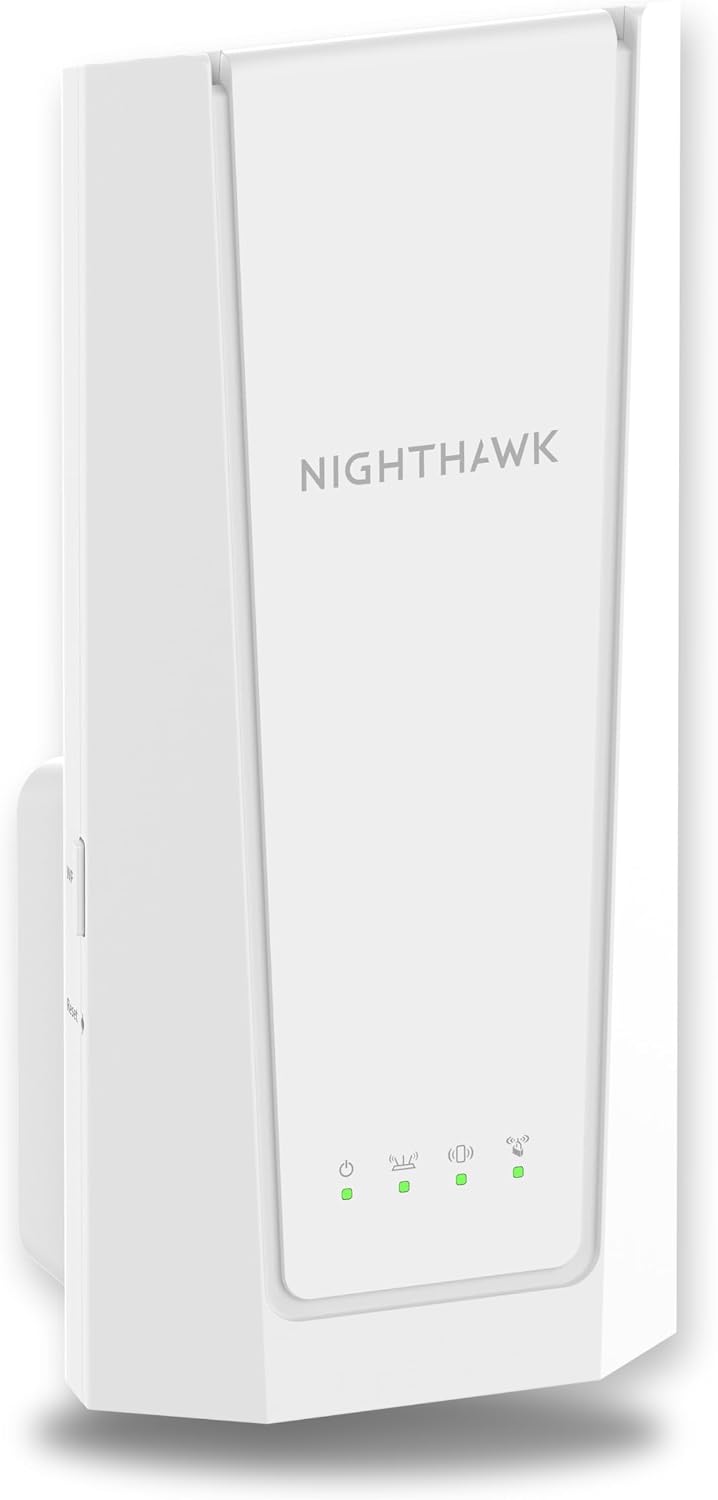
If you’re planning to keep your extender for several years, stepping up to a newer WiFi-7 model may be worth considering. The NETGEAR EXS25 offers stronger performance, support for more connected devices, and advanced security features while maintaining the simple setup many users appreciate.
Real User Reviews & Feedback on Net Boost
What we could and could not verify:
- We did not find independent hands-on tests of NetBoost-branded units from established review outlets. The glowing “reviews” that appear in search results are mostly seller listings and promotional pages, not tests.
- A consumer report filed on BBB Scam Tracker in January 2025 describes ordering a “NetBoost Pro” through the brand’s own website and receiving a different extender than the one ordered. The reporter measured speeds next to the extender that were far below what their router alone delivered, and a refund request was still open. BBB notes that these reports are unverified consumer accounts, and this is a single report, not proof of how every order goes.
- Listings on eBay and Newegg show the product under several names and specs, often with a generic or missing brand field, with return terms ranging from no returns to 60 days (buyer pays return shipping).
Known limitations of this type of extender:
- It extends range but does not add speed. In repeater mode, throughput typically drops to roughly half of what the extender receives from your router.
- Advertised coverage of 7,998 to 9,998 sq. ft. is not realistic for a single plug-in repeater; plan on roughly 1,000 to 3,000 sq. ft. depending on walls and placement.
- Performance drops through thick walls, floors, and in areas with heavy interference.
Bottom line: A basic repeater like this can work for a simple dead-zone fix on a tight budget, but it is not a replacement for a supported extender or a mesh system, and the lack of a clearly identifiable manufacturer is a real reason to be careful about where you buy.
Step-by-Step Setup Guide for NetBoost WiFi Extender
- Plug in near router (within strong signal range).
- Press WPS on router, then on NetBoost (or manual via browser: connect to NetBoost SSID → 192.168.188.1 or similar → enter router WiFi details).
- Wait for LED to show connection (solid green/blue).
- Move to dead zone and plug in.
- Connect devices to the new/extended SSID.
Advanced: Use Ethernet cable for access-point mode (better speed/stability).
Troubleshooting: Reset (hold button 10s), check LED guide, ensure router WPS enabled.
Tips to Maximize NetBoost Performance
- Place halfway between router and dead zone (test signal with phone apps).
- Avoid interference (microwaves, cordless phones, thick metal).
- Use 5GHz band where possible for speed (if dual-band model).
- Update router firmware for best compatibility.
- Consider 2 units for very large homes.
When to upgrade: If NetBoost doesn’t cut it, switch to mesh (Eero, Google Nest, TP-Link Deco) for seamless whole-home coverage.
Alternatives to NetBoost
Better options if NetBoost isn’t right:
- TP-Link RE315/RE715X Best overall/value (WiFi 6, stronger performance).
- Netgear Nighthawk EAX series: High-speed, mesh-ready.
- Linksys RE7310 Solid WiFi 6 value.
- Check out our Best TP-Link WiFi Extenders to Boost Your Home Coverage
For larger homes, mesh systems outperform basic extenders every time.
NetBoost WiFi Extender FAQ
Is NetBoost legit? It is a real, physical plug-in WiFi repeater, and the basic technology is ordinary. What is harder to establish is who stands behind it. The listings we checked show generic or missing brand details, coverage claims far above what this class of device can deliver, and return terms that vary by seller. A consumer report on BBB Scam Tracker (January 2025) describes receiving a different extender than the one ordered. That report is unverified and is only one account, so treat it as a caution about where you buy rather than a verdict on every unit.
Is NetBoost the same as Bivo NetBoost or NetBoost X? Shoppers search for it under several names, including “Bivo NetBoost” and “NetBoost X.” We could not confirm a single manufacturer behind any of these names, and listings show different specs under the same name, for example a 300 Mbps single-band version versus a 1,200 Mbps dual-band “Pro.” Check the exact model, bands, and seller on the listing rather than relying on the name.
How much coverage will it really give? Plan on roughly 1,000 to 3,000 sq. ft. depending on walls and placement, not the 7,998 to 9,998 sq. ft. shown in listings. Placing it about halfway between your router and the dead zone matters more than any spec.
Will it make my internet faster? No. An extender extends range, it does not increase the speed your provider delivers, and in repeater mode throughput typically drops to roughly half at the extended location.
Where should I buy one if I decide to try it? Anywhere you have a guaranteed return and buyer protection. Avoid listings marked “no returns,” confirm exactly which model is included, and keep the packaging until you have tested it in the actual dead zone.
Conclusion: Is the NetBoost WiFi Extender Worth It in 2026?
Possibly. If you’re on a tight budget, need a quick fix for one small dead zone, already have a decent router signal, and buy from a seller with a guaranteed return. The setup is simple, but the product itself comes with more unknowns than a TP-Link or NETGEAR extender.
No. If you need maximum speed (gigabit plans), heavy gaming/streaming, or coverage in challenging environments (thick walls, long distances). In those cases, step up to TP-Link RE715X or a full mesh system.
Final recommendation: If you still want to try a NetBoost-branded extender, buy it only from a marketplace with a clear return policy and confirm returns are accepted before you order (we saw listings with no returns at all). Keep the order confirmation and packaging, and check that what arrives matches the listing. If you would rather have a manufacturer’s warranty and a support team behind the purchase, a TP-Link or NETGEAR extender costs more but removes that uncertainty.
Whichever extender you choose, test it in the actual dead zone during the return window and keep proof of purchase.